Add Us As A Trusted Google Source
 WW-Friendly Mexican Recipes for Two
»

The complete meal prep guide written specifically for two-person households — not the family-sized complete guide. This is the system that addresses what is actually different about meal prepping for two and how I handle it here at home. Here is what you will find:
Every meal prep guide online — including the authoritative ones from Harvard’s Nutrition Source, Clean Eatz Kitchen, and the major food blogs — is written for households of four to six. The strategies they recommend (batch-cook a full tray of chicken, make a large pot of grains, prep four to six portions of each component) fail for two-person households in specific, predictable ways that nobody in the meal prep space is addressing directly. It’s not that you can’t prep in volume or have days and days worth of food prepped and ready to go, it is more that I just can’t bear to eat the same thing over and over again all week. Do you feel me? I’m a foodie, for crying out loud, I like food and I want to enjoy it, so diversity is key for me. Now, don’t get me wrong, there are some things and some meals I eat every week (I really like some basic grilled chicken and steamed broccoli…I know, that sounds boring, but it fills me up, is real good “clean eating” and hits all my goals for WW-friendly meals. But when it comes to meal prep for two, I aim for variety. You’ll see what I mean.
| Family Meal Prep Advice | What Happens at Two-Person Scale | The Two-Person Fix |
|---|---|---|
| Batch-cook 6-8 chicken thighs | Eating the same protein 3-4 days in a row — leads to WW boredom and plan abandonment | Prep 2 proteins in small batches, different preparations |
| Cook a large pot of grains (4 cups dry) | 10+ servings for two people — impossible to eat before quality degrades | Cook 1 cup dry (3-4 servings) maximum per grain batch |
| Prep all vegetables for the week | Later-week vegetables are limp, discolored, and unappealing by Thursday | Prep Monday-Wednesday vegetables; buy Thursday-Friday fresh or use frozen |
| Make 6 identical meal containers | Both people eat the exact same lunch Monday through Thursday — kills motivation | Prep components, not complete meals — mix and match daily |
| Use a large sheet pan for roasting | Too much empty space for 2 portions — steaming not roasting | Use quarter-sheet pan; prep for 2, not 6 |
| Freeze half the batch | Freezer fills with identical meals — no variety in reserve | Freeze strategically: soups yes, grain bowls no, proteins maybe |
The core insight: two-person meal prep is not family meal prep at a smaller scale. It is a different philosophy — one that prioritizes component flexibility over complete meal consistency, variety over volume, and quality over quantity. Once you build the system around that philosophy rather than fighting against it, meal prep for two becomes genuinely effortless rather than a weekly exercise in willpower.
You’ll note I call for a mid-week grocery store run for fresh produce. I don’t like limp veggies (save those for a great chicken stock and making my chicken & rice soup for two is a piece of cake!). So, I almost always go out for fresh produce mid-week. I would love living in Europe where the norm is to shop everyday for fresh fruit, veggies and bread…sounds like heaven to me! BUT, I get it if that’s not your thing. In that case, have a great stash of frozen veggies on hand. My freezer always has frozen corn, peas, carrots, spinach, edamame and broccoli. This way, if I can’t get out or don’t want to do that mid-week run, I’m good to go.
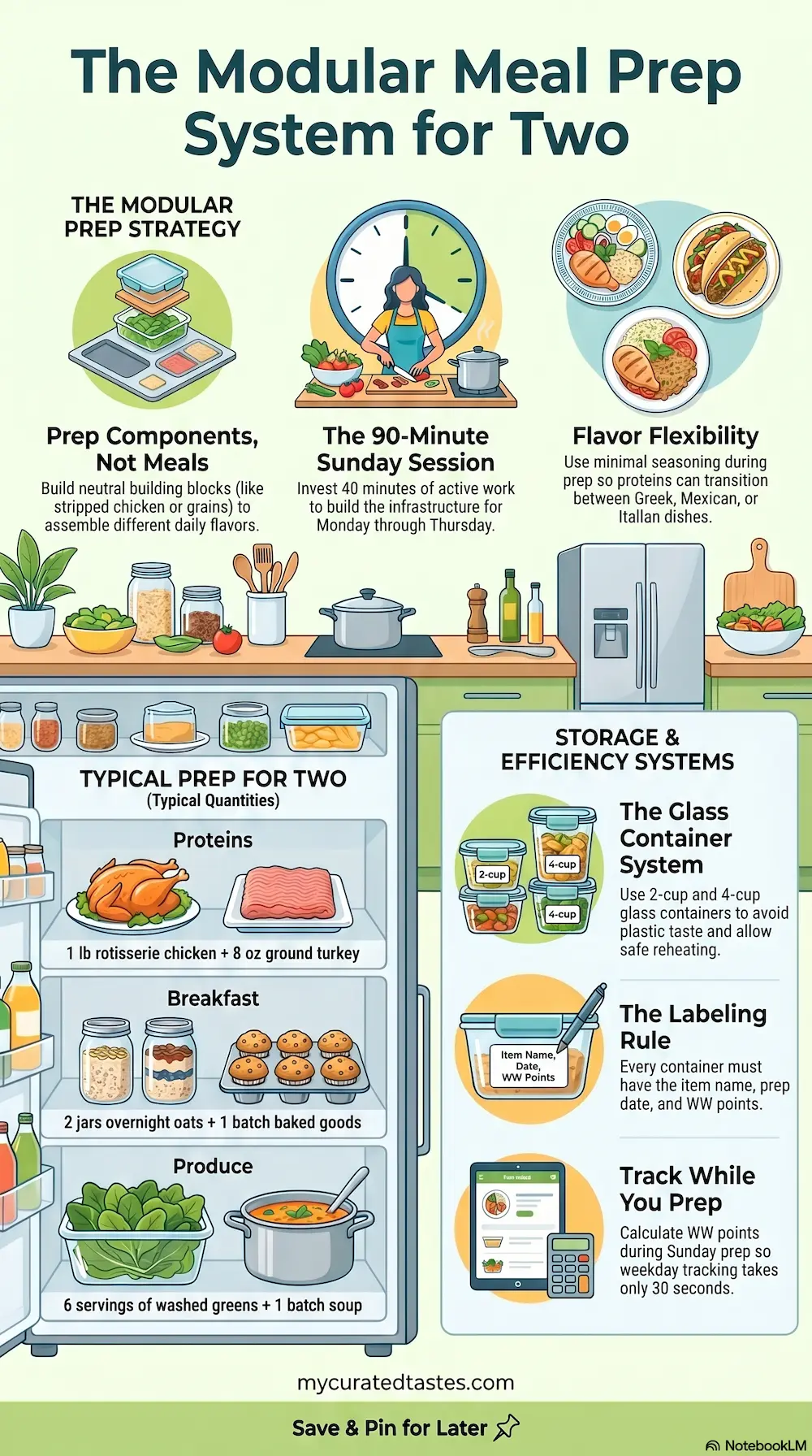
The foundational principle of two-person meal prep is this: prep components, not complete meals. The family meal prep model — identical containers in the fridge, same breakfast/lunch/dinner every day — fails for two people because the portion is too small to sustain interest for four or five days. The solution is a modular system where Sunday’s 90 minutes produces building blocks that assemble into genuinely different meals each day of the week. Personally, I think this is genius and didn’t realize it was an actual “philosophy” until I spoke with people who didn’t do this. Believe me, you’ll never be bored again…you’ll just be prepared. And if you are on a budget (and who isn’t?) you’ll want to see my Cooking for Two on A Budget Guide.
BATCH (Cook fully Sunday, use all week): Proteins that hold well — rotisserie chicken stripped and portioned, hard-boiled eggs, cooked and chilled shrimp, ground turkey browned with basic seasoning, batch soups, overnight oats, baked goods like Skinny Everything Bagels. A bowl of classic hummus and Kiwano salsa provide dips, sandwich spreads and protein toppings all week. I also might toast some nuts, and/or make a batch of everything bagel seasoning plus. These items require zero cooking Monday through Friday — just assembly.
SEMI-PREP (Partial prep Sunday, finish quickly on the night): Marinated raw proteins ready to cook in 15 minutes, washed and dried greens, chopped aromatics (garlic, shallots), blanched vegetables that reheat in 90 seconds, sauces and dressings that finish in 2 minutes. These items require 5–15 minutes of active cooking on weeknights but make that cooking genuinely fast.
COOK FRESH (Do not prep in advance): Fish and seafood (quality degrades rapidly when pre-cooked), most pasta dishes (pasta absorbs sauce and becomes gluey), anything with avocado (browns within hours), salads with dressing (wilts), dishes whose appeal is specifically the freshness of just-cooked. For these, the Sunday prep provides the mise en place (measured sauces, prepped vegetables) but the cooking happens on the night. One exception on pasta: I’ll par cook a cup of whole wheat elbow noodles and put in a small container in the fridge. I can then add some to my individually portioned healthy minestrone soup when I reheat it. Keeps the noodles Al Dente and boosts the soup making it heartier.
This is the system I have used every Sunday for over a decade. It takes 90 minutes of which approximately 40 are active and 50 are passive (waiting for things to cook). It covers breakfast, lunch, snacks, and dinner components for Monday through Thursday.
| Time | Active Task | Passive/Concurrent Task |
|---|---|---|
| 0:00–0:05 | Preheat oven to 425°F. Put eggs on to boil. | Fill sink with cold water for egg ice bath |
| 0:05–0:15 | Strip rotisserie chicken; separate white/dark meat into containers | Eggs boiling (12 minutes) |
| 0:15–0:25 | Make 2 jars overnight oats (different flavors) | Eggs still boiling |
| 0:25–0:30 | Transfer eggs to ice bath; prepare marinade for Tuesday’s protein | Marinate protein in fridge |
| 0:30–0:40 | Wash and dry all salad greens; store in bag with paper towel | Oven preheating |
| 0:40–0:50 | Prep vegetables for Monday–Wednesday: chop, portion into containers | Peel and store hard-boiled eggs |
| 0:50–1:05 | Make one batch dressing* or sauce (Caesar, vinaigrette, or pan sauce base) | Vegetables chilling |
| 1:05–1:20 | Toast nuts; make one batch snack (truffles, protein bars, or cookies) | Snack setting/chilling |
| 1:20–1:30 | Label everything. Organize refrigerator by day (Monday front, Thursday back). |
*A simple lemon and thyme vinaigrette dressing or my pistachio basil pesto will work all week long to enhance your meals.
Total active time: approximately 40 minutes. Total passive time: approximately 50 minutes. Everything produced in this session — the chicken, eggs, overnight oats, dressings, prepped vegetables, and snacks — forms the complete infrastructure of Monday through Thursday for two people. Friday and Saturday are either fresh-cook nights or planned restaurant/delivery nights.
The session is designed around parallel processing — while the eggs boil, you strip the chicken. While the oven preheats, you make the overnight oats. While the snack sets in the fridge, you label everything. Nothing in this session requires your full attention for its entire duration. The goal: zero idle waiting time during the 40 minutes of active work. Every waiting period is filled by an active task on something else. This is the professional kitchen principle of mise en place and parallel cooking applied to home meal prep.
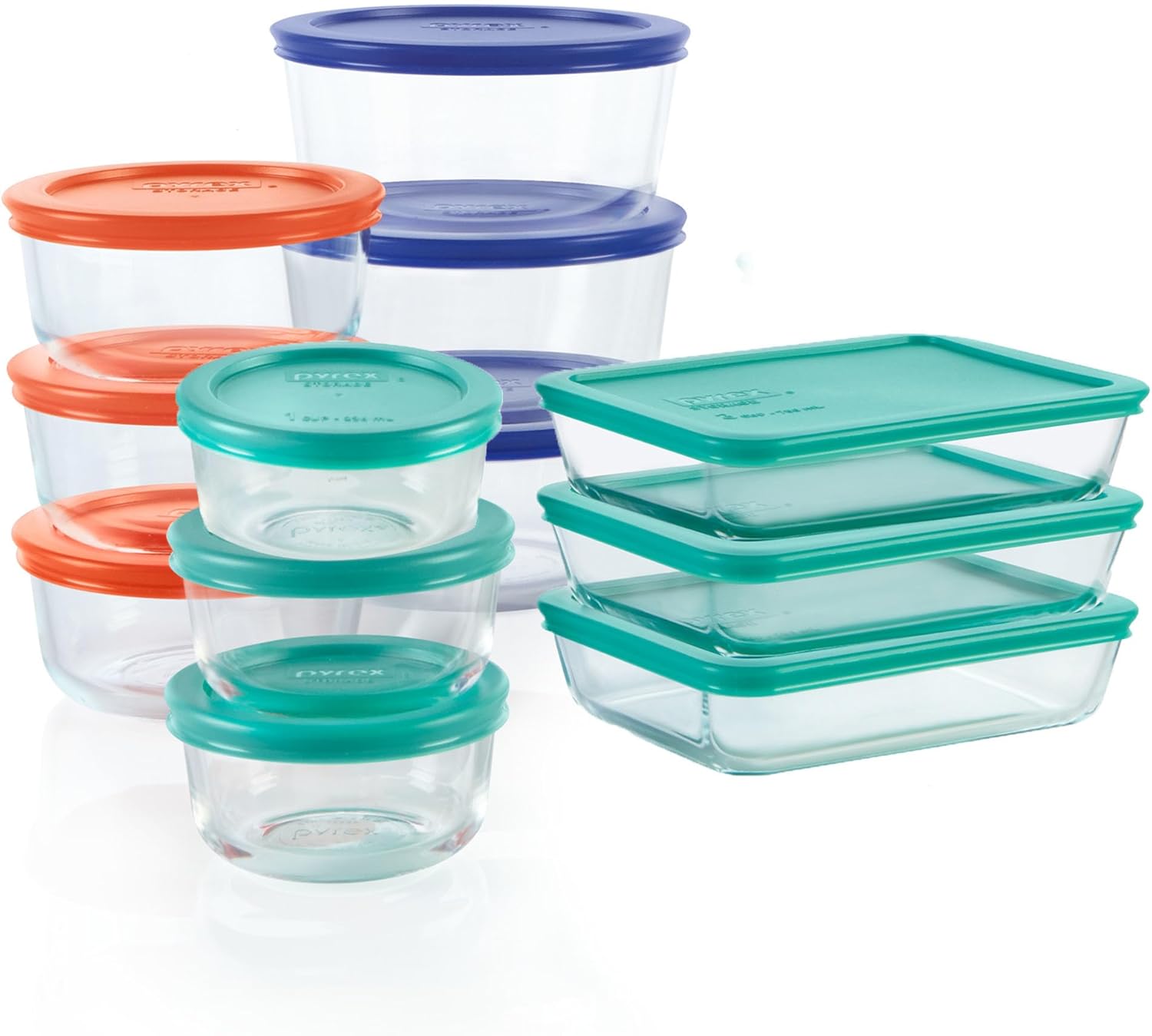
The container system determines whether meal prep is a joy or a frustration. The right containers make the system almost automatic; the wrong ones create a weekly friction that eventually ends the habit. Here is the exact system I use:
| Container Type | Quantity, Size & Use |
|---|---|
| Wide-mouth mason jars (16 oz / pint) | 8 jars — overnight oats (2), individual dressings (2), yogurt portions (2), snack storage (2) |
| Wide-mouth mason jars (32 oz / quart) | 4 jars — soup portions (frozen flat), large salad prep, bulk dressing |
| Glass meal prep containers (2-cup, rectangular) | 6 containers — cooked protein portions (2 per protein type), vegetable portions, grain portions |
| Glass meal prep containers (4-cup, rectangular) | 4 containers — full lunch portions (protein + vegetable assembled), larger grain batches |
| Small lidded glass bowls (1-cup) | 4 bowls — chopped aromatics (garlic, shallots), prepped herbs, cut fruit |
| Zip-lock freezer bags (quart size) | Always stocked — protein marinades, frozen soup portions, portioned nuts |
| Zip-lock freezer bags (gallon size) | 4–6 per week — washed greens with paper towel, bulk frozen items |
| Label tape and Sharpie | The most important non-container item — nothing gets stored without a label and date |
Total container investment: approximately $50 for the full glass container system (Pyrex is a good brand for longevity and oven-safe versatility). The investment pays back within one month of reduced food waste and fewer takeout meals. Avoid plastic containers for anything that will be reheated — the glass system is safer, lasts longer, and produces no plastic taste transfer to food. And if you are like me, I hate the “stains” left on plastic containers. I don’t care how much I wash them, they never come out!!!
The labeling system is non-negotiable. Everything that goes into the refrigerator or freezer gets a label with the item name and the date it was prepped. Without the label, you will open a container on Thursday and have no idea if it is safe to eat. With the label, the system is self-managing.
| Prepped Item | Refrigerator Life | Freezer Life |
|---|---|---|
| Hard-boiled eggs (peeled) | 1 week | Not recommended — texture degrades |
| Stripped rotisserie chicken (white meat) | 4 days | 3 months in freezer bags |
| Cooked and chilled shrimp | 4 days | 3 months |
| Ground turkey (cooked, basic seasoning) | 4 days | 3 months |
| Marinated raw chicken (uncooked) | 2 days | Freeze the marinade bag directly |
| Overnight oats (assembled jars) | 5 days | Not recommended — texture changes |
| Washed and dried salad greens | 5 days (with paper towel) | Not recommended |
| Cooked grains (quinoa, rice) | 5 days | 3 months |
| Batch soups | 4 days | 3 months (best freezer item) |
| Homemade dressings (dairy-free) | 1 week | Not recommended |
| Homemade dressings (dairy-based) | 4 days | Not recommended |
| Sugar-Free Chocolate Protein Truffles | 1 week refrigerated | 1 month frozen |
| Skinny Everything Bagels (baked) | 1 week refrigerated, sliced | 1 month frozen, individually wrapped |
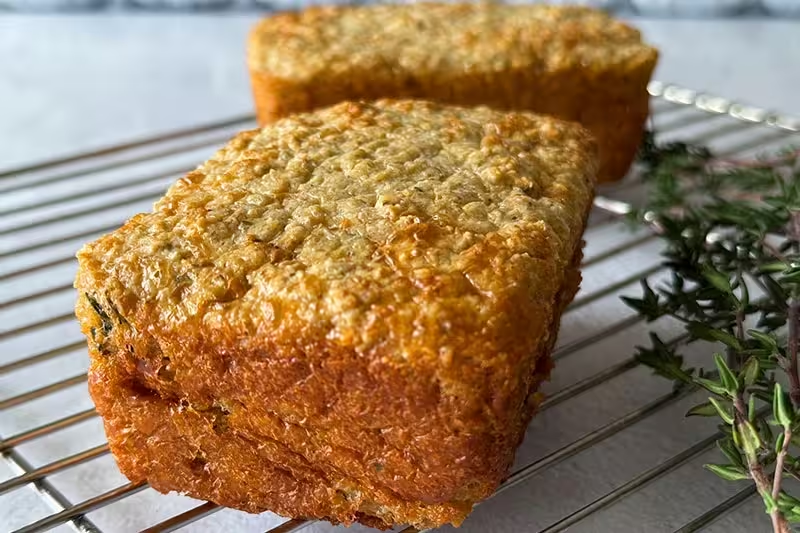
| Cottage Cheese Bread with Oatmeal | 5 days refrigerated, sliced | 1 month frozen |
| Cannellini Bean and Sausage Soup | 4 days | 3 months — the ideal batch-freeze soup |
| Healthy Minestrone Soup | 4 days | 3 months — designed for batch freezing |
This is the most nuanced section of any two-person meal prep guide and the one nobody covers adequately. The question is not ‘can this be prepped?’ — almost anything can. The question is ‘does prepping this improve or diminish the final result?’ Here is the decision framework:
Prep in advance if: The item improves with time (flavors meld, texture develops). The item requires significant active cooking time that is a burden on a weeknight. The item freezes well and can be used over weeks rather than just days. Making it in advance eliminates a specific point of weeknight stress. Examples: the Apricot Chicken Salad with Dill (genuinely better on day two), all soups (always better the next day), all dressings (flavors meld), overnight oats (designed for advance prep).
Cook fresh if: The item is specifically about freshness — fish, seafood, anything with avocado. The item takes 15 minutes or less to cook on the night (Cast Iron Scallops, scrambled eggs, simple pasta). The item changes texture unpleasantly when stored (pasta absorbs sauce, lettuce wilts with dressing). The visual presentation is important and would be diminished by storage. Examples: all fresh fish, scallops, any pasta served hot.
Semi-prep: Marinate the protein Sunday so Monday’s 15-minute cooking becomes 12-minute cooking with deeper flavor. Wash and chop vegetables that take more time to prep than to cook. Pre-mix spice blends and dry rubs so they are ready to apply. Pre-measure and refrigerate sauce ingredients in a small jar so the sauce takes 60 seconds rather than 3 minutes.
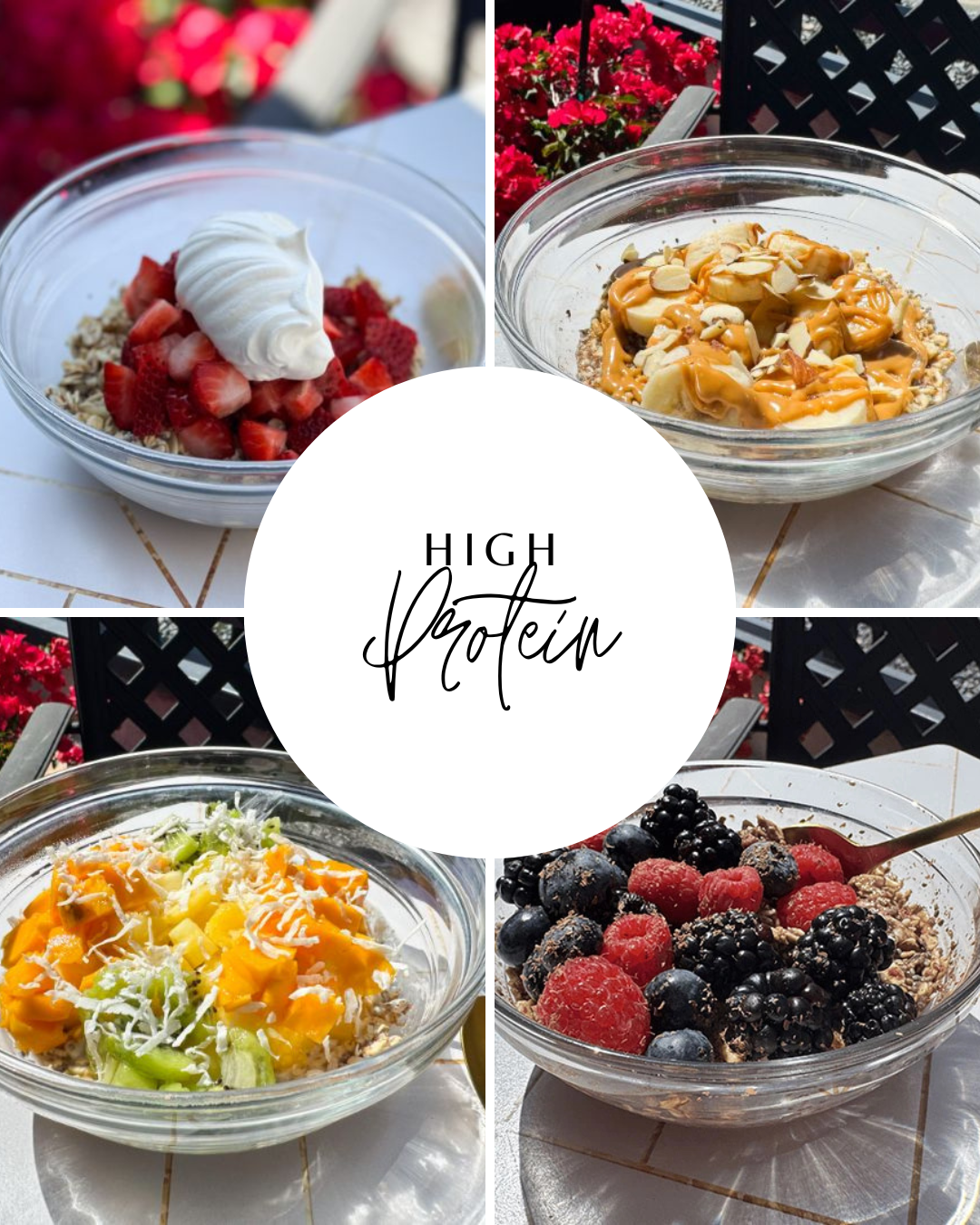
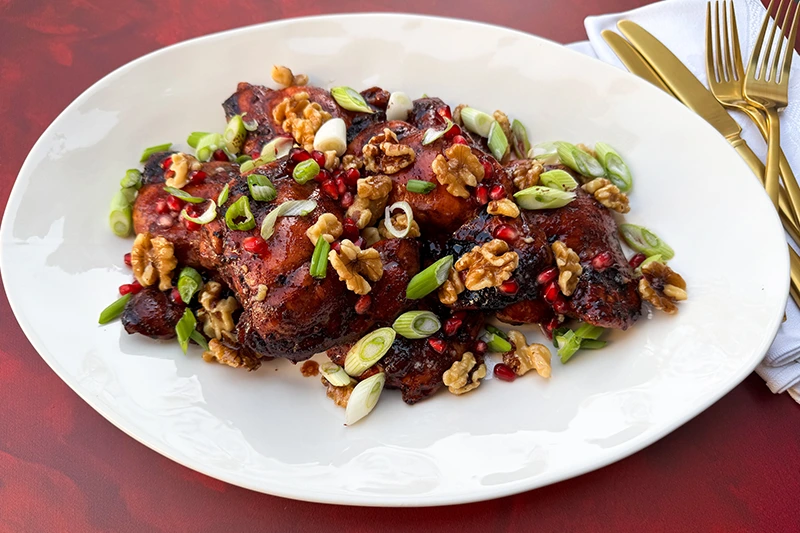
Organized by meal category. Every recipe below has been verified as meal-prep compatible at two-person scale.


Meal prep and WW points tracking are structurally compatible in a way that makes each one more effective when combined with the other. Here is the integration:
For the complete WW approach to eating for two: Cooking for Two on Weight Watchers. For the zero-point meal formula: Zero-Point Recipes for Two.
Meal prep is the most effective strategy available for consistently hitting daily protein targets — because it moves the protein decision from a daily choice to a weekly system. Here is the protein architecture that the Sunday session creates:
| Prepped Item | Protein Per Serving | Meals It Covers |
|---|---|---|
| Stripped rotisserie chicken (4 oz) | 25–30g | Mon–Wed lunches and salads |
| Hard-boiled eggs (2) | 12g | Daily snack or breakfast addition |
| Cooked shrimp (4 oz) | 24g | Salad topping or quick dinner |
| Overnight oats (per jar) | 25–35g | Mon–Tue breakfasts |
| Ground turkey (4 oz, basic seasoning) | 22g | Lettuce wraps, pasta sauce, canoes |
| Protein truffles (2 truffles) | 8g | Daily snack |
| Fat-free cottage cheese (½ cup) | 14g | Added to any meal as zero-point protein booster |
With these seven items prepped Sunday, a two-person household reaches 25–35 grams of protein at every meal Monday through Thursday without any additional planning. The protein is already there. For the full high-protein recipe collection: High-Protein Recipes Guide. For high-protein breakfast prep: High-Protein Breakfasts for Two. For high-protein lunch assembly: High-Protein Lunch Recipes for Two.
Start with the Sunday 20-Minute Infrastructure Session described in the Meal Planning for Two guide before attempting a full 90-minute prep session. The 20-minute version covers only the highest-impact items: strip a rotisserie chicken, hard-boil 6 eggs, make two jars of overnight oats, and wash salad greens. This covers Monday through Wednesday breakfast and lunch for two people in 20 minutes. Once this habit is established (typically 3–4 weeks), expand to the full 90-minute session that adds dinner semi-prep, snacks, and dressings. The most common meal prep failure mode: attempting the full system on the first try, finding it overwhelming, and abandoning it entirely. Build incrementally.
For two adults, a typical Sunday prep covers: two protein types (approximately 1 pound total of each — half a rotisserie chicken plus 8 oz of ground turkey), two breakfast options (two overnight oats jars plus one baked good), one or two salad dressings (enough for 6–8 servings), one batch soup (2–4 servings — either for this week or freeze), washed greens for 6 salads, and one snack batch (truffles, bars, or cookies). This covers Monday through Thursday with variety for two people. The guiding principle: enough to avoid daily cooking decisions Monday through Thursday, not so much that identical meals dominate every day. Friday and Saturday should be fresh-cook or restaurant nights — they need no prep.
For two-person meal prep, the best container system uses 2-cup and 4-cup glass rectangular containers (Pyrex or OXO) for protein and grain portions, 16-ounce wide-mouth mason jars for overnight oats and dressings, and quart-size mason jars for soup portions and bulk dressings. Glass is strongly preferred over plastic for reheating safety, flavor transfer prevention, and longevity. For a two-person household, six 2-cup containers and four 4-cup containers plus eight mason jars (various sizes) covers the complete prep system. The total investment is approximately $60–80 and lasts years. Add a label tape roll and a Sharpie as the most important non-container purchase — nothing goes into the fridge or freezer without a name and date.
The solution is the component-based approach rather than the complete-meal approach. Instead of making six identical chicken-and-rice containers, prep the stripped rotisserie chicken as a neutral component, cook a grain base, make two or three different dressings or sauces, and wash greens. Monday’s lunch is chicken Caesar salad. Tuesday’s is apricot chicken in lettuce cups. Wednesday’s is chicken over greens with balsamic vinaigrette. All three use the same prepped chicken; none taste the same. This approach is described in full detail in the Two-Person Meal Prep Philosophy section of this post. The key rule: prep proteins plain or with minimal seasoning so they work across multiple flavor profiles, rather than fully seasoned for one specific preparation.
A complete two-person Sunday prep session takes 90 minutes — approximately 40 minutes of active work and 50 minutes of passive time (waiting for things to cook, cool, or set). This compares favorably to the USDA estimate cited by multiple meal prep guides that the average American spends over five hours per week on cooking and cleanup. The 90-minute Sunday investment saves approximately 3–4 hours of weeknight cooking time across the five days — a net weekly time savings of 2–3 hours. For beginners, start with the 20-minute mini-prep session (rotisserie chicken, hard-boiled eggs, overnight oats) and build from there. The 90-minute full session is achievable once the habit is established.
Meal planning and meal prep are distinct activities that work together rather than either/or. Meal planning is the cognitive work — deciding what to eat, checking the pantry, writing the grocery list, scheduling when to cook what. Meal prep is the physical work — the Sunday session that produces the cooked and prepped components. Both matter. Without meal planning, the meal prep session lacks direction — you prep things but not necessarily the things that form a coherent week. Without meal prep, the meal plan exists only on paper — a beautiful plan that falls apart on Tuesday when dinner takes too long. The relationship: meal planning tells you what to buy and when to eat it; meal prep makes the plan automatic rather than aspirational. For the complete meal planning framework that precedes and directs the prep session, see the Meal Planning for Two guide. The prep session in this post is the physical execution of that plan.
The component-based meal prep approach solves the different-preferences problem structurally. When you prep proteins, grains, and vegetables as neutral components rather than complete meals, each person customizes the assembly at lunchtime or dinnertime. The stripped rotisserie chicken goes on one person’s Caesar salad and the other person’s grain bowl with completely different toppings and dressings. The prepped ground turkey becomes one person’s lettuce wraps (lighter) and the other’s pasta sauce (more substantial). The key technique: keep seasoning minimal during prep so the same prepped protein can take any flavor direction. A plain rotisserie chicken can become Greek salad, Asian lettuce wraps, Mexican taco filling, or Italian pasta topping — the same prep, four completely different meals. For the complete mixed-preferences cooking approach for two people, see the Complete Guide to Cooking for Two.
The four-week rotation system is the answer. Rather than trying to vary every week’s prep from scratch — which requires creative energy you may not have on every Sunday — build a four-week rotation of prep sessions where each week emphasizes a different protein and flavor profile. Week 1: chicken-forward (Caesar salad, apricot salad, chicken rice soup). Week 2: turkey-forward (lettuce wraps, zucchini canoes, ground turkey pasta sauce). Week 3: seafood-forward (shrimp for salads, salmon marinated, scallops for Monday dinner). Week 4: egg and legume-forward (egg salad, minestrone, chickpea bowls). After four weeks, start the rotation again with seasonal ingredient adjustments. The rotation requires planning once (to set it up) rather than weekly (to reinvent it). The snack and breakfast components rotate on a 2-week cycle independently of the protein rotation, creating genuine variety across meals even as the protein backbone follows a predictable pattern. See the WW-Friendly Meal Plan for Two — 7 Days for a complete worked week that demonstrates this rotation in practice.
Ninety minutes on a Sunday afternoon is a small investment. It eliminates the daily ‘what’s for dinner?’ negotiation. It makes the 3pm snacking crisis a non-event because the truffles are already in the fridge or I’ve got a couple of tri-color kiwi Greek Yogurt desserts ready to go! It makes WW tracking accurate because the points are already written on the label. It makes Monday morning a matter of opening the refrigerator rather than cooking.
The two-person meal prep system in this guide is not the family approach scaled down. It is a different philosophy — component-based, variety-first, quality-preserving — built specifically for the way two adults actually cook and eat. Once you build the system around that philosophy, the 90 minutes on Sunday stops feeling like a chore and starts feeling like the best investment in the week.
For the complete two-person cooking framework: Complete Guide to Cooking for Two. For the meal planning layer that directs the prep: Meal Planning for Two. For the high-protein recipe collection that makes prep worth doing: High-Protein Recipes Guide. For the WW integration: Cooking for Two on Weight Watchers. For budget-smart prep: Cooking for Two on a Budget.

Hi! I’m Diane. I started this site as a passion project. I love to cook, entertain, travel and laugh. (Who doesn’t love a good laugh?) Of course, being from New York, sarcasm rules!
More About Diane
mycuratedtastes@gmail.com