Add Us As A Trusted Google Source
 High-Protein Snacks — What I Actually Reach For Most
»


A complete guide to cooking for two after the kids leave — written not as a condolence but as a genuine celebration of everything this chapter makes possible. Here is what makes this post different from Taste of Home’s list of 45 recipes or One Dish Kitchen’s 50+ roundup:
Let me tell you something that most empty nest cooking guides are too polite to say outright: the moment your last child leaves home and you are standing in your kitchen thinking ‘what do I do with all this?’ — that is not a problem. That is an opportunity so significant it could genuinely change the trajectory of your health for the next twenty years if you let it. You control everything coming into the house…no more bags and bags of snacks and treats for the crowd. You can select the perfect two apples, the perfect two healthy snacks, your health becomes a priority and your eating changes.
I have been cooking for two in Orange County in Southern California for over a decade. Not because my children left — my situation was different — but because two people is my baseline, and I have built an entire approach to cooking around it. What I know from that experience is this: cooking for two, done well, is the best cooking you will ever do. Better ingredients. More variety. Perfect portions. No more cooking to the lowest common denominator of a family’s tastes. No more eight-serving batches of something one person barely tolerates. Just two adults who can eat exactly what they actually want, when they want and how they want! It is amazing how liberating it is and how exciting and joyful cooking and eating becomes. It is also easier to control costs and cooking for two on a budget isn’t drudgery, it is a challenge I love! And Meal Prep for Two is 10x easier than prepping for a big family…trust me, the joy of cooking is going to come back during the phase of your life.
This post is for you: the empty nester standing in a kitchen that suddenly feels too big, staring at recipes that serve six, wondering how to make the transition. The answer is not to scale everything down indefinitely. The answer is to reimagine the kitchen entirely as a two-person operation from the ground up. That is what this guide does.
For the complete technical guide to cooking for two — including scaling math, pan sizes, and the two-person weekly framework — visit the Complete Guide to Cooking for Two. For all WW-friendly recipes on this site, see the WW-Friendly Recipes Guide. And for the high-protein approach to empty nest eating, see the High-Protein Recipes Guide.
Every empty nest cooking guide online opens with something reassuring about how exciting and freeing this new chapter is. And it is. But let me honor the real experience first, because pretending the transition is seamless does not help anyone.
The empty nest transition coincides almost exactly with the life stage at which nutrition becomes the most consequential it has ever been. For most people, the last child leaves home somewhere between their late forties and late fifties — precisely the years when the body’s relationship with protein, muscle mass, and metabolism changes fundamentally.
The Science: Protein at 50+ Is Non-Negotiable
Age-related muscle loss — called sarcopenia — begins in your 30s and accelerates after 50. Research published in the American Journal of Clinical Nutrition found that protein intake in midlife is strongly associated with healthy aging, with plant proteins showing particular benefits for women. The updated 2025–2030 Dietary Guidelines for Americans recommend 1.2–1.6 grams of protein per kilogram of body weight daily for adults over 50 — significantly higher than the previous standard. For a 150-pound person, that is 82–109 grams of protein per day.
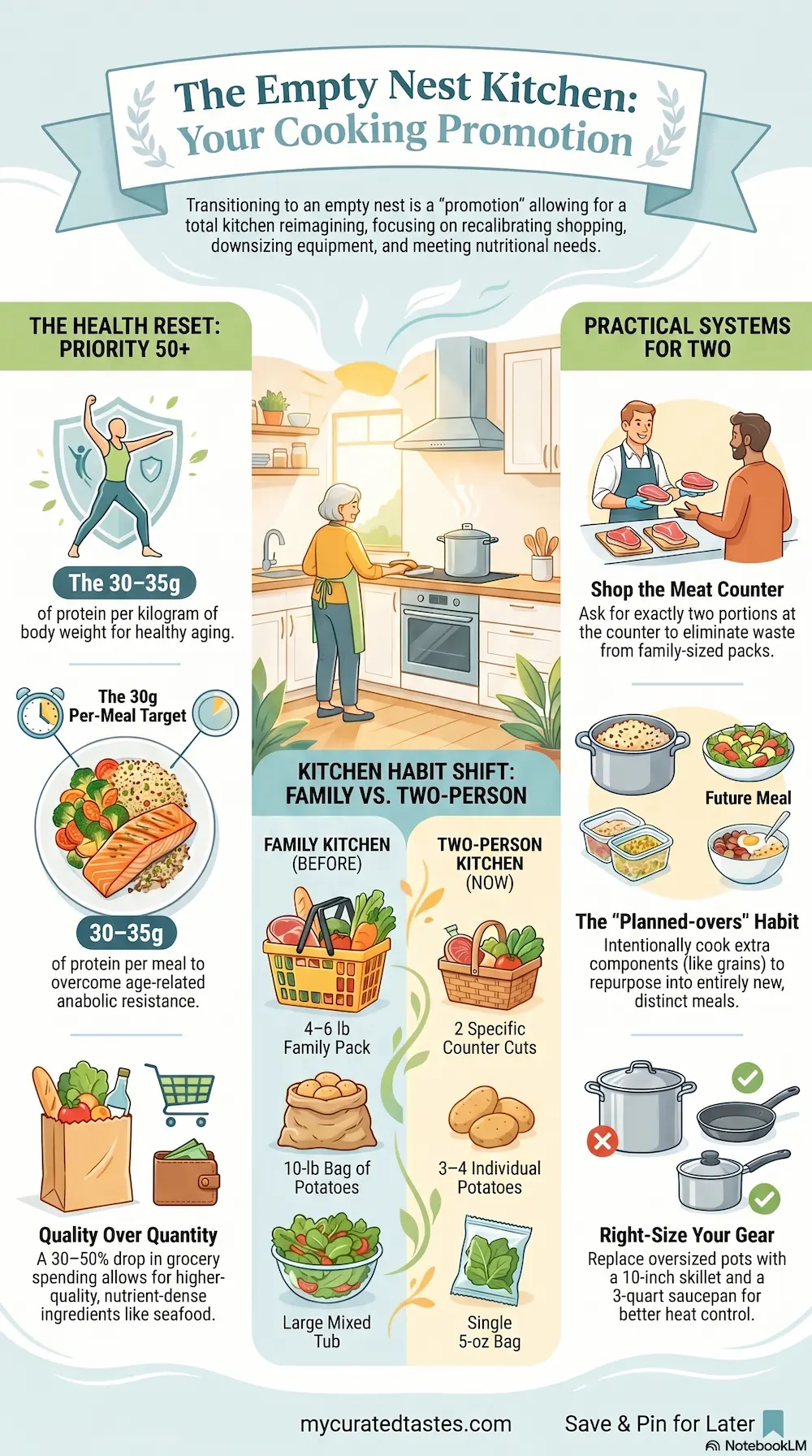
Registered dietitians at Stanford’s Lifestyle Medicine program recommend 30–35 grams of protein per meal for adults over 50, citing anabolic resistance — the body’s decreasing efficiency at using dietary protein — as the reason higher per-meal amounts are needed to trigger the same muscle protein synthesis that lower amounts would have achieved at 30.
The practical translation: the empty nest is the exact moment to start building every dinner around a protein anchor of 30+ grams. Not as a fitness obsession, but as a fundamental investment in how you will feel and function for the next twenty years.
I have been a WW member for more years than I want to count, and I can tell you with complete confidence: the WW program and empty nest cooking for two are almost perfectly designed for each other. Here is why.
The grocery store is designed for families. Almost everything is packaged in quantities that made sense when you had a full house but create waste and over-spending for two. Here is how to recalibrate:
| Before (Family Kitchen) | Now (Two-Person Kitchen) | Why It Matters |
|---|---|---|
| Family-size chicken package (4–6 lbs) | Two specific cuts from the counter | No waste, better quality, fresher |
| Large bunch of fresh herbs | Herb plant on the windowsill | Lasts weeks, use daily, costs less |
| 10-lb bag of potatoes | 3–4 individual potatoes | No waste, can try different varieties |
| Large family-size yogurt | Individual containers or small tub | Stays fresh, less temptation |
| Multiple snack items for kids | None — or just one quality choice | Cleaner pantry, lower grocery bill |
| One protein for the whole week | 2–3 different proteins in small quantities | More variety, fresher, more interesting |
| Large container of mixed greens | Single-serve bag (5 oz) | Uses up before it wilts |
Most kitchens accumulate equipment sized for feeding a crowd. Some of it can stay — a good Dutch oven, a sheet pan, a stand mixer for baking. Some of it should be supplemented with smaller pieces designed for two. Here is what actually matters:
Every recipe below is designed for or naturally sizes to two servings. All are from My Curated Tastes. I have organized them by category — weeknight dinners, weekend showstoppers, comfort food, brunch, and dessert — because the empty nester kitchen needs all of them.
These are the dinners for Monday through Thursday: 20–35 minutes, minimal cleanup, genuinely delicious.
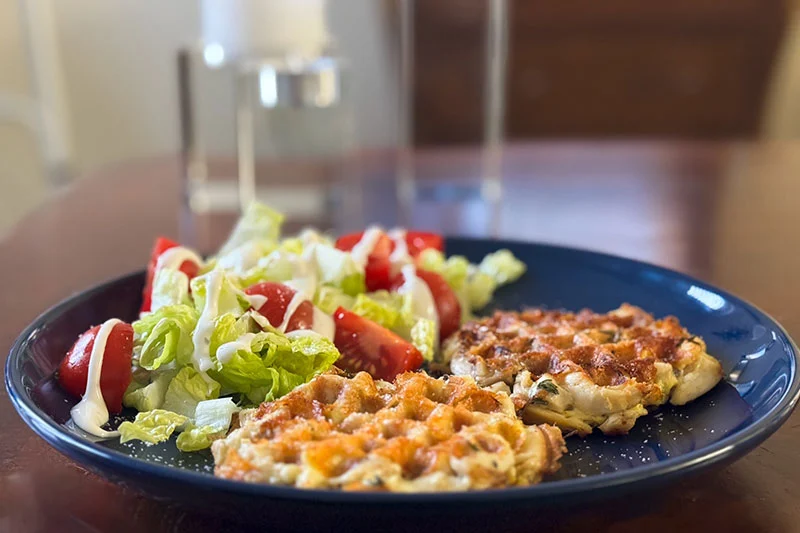
High-Protein Waffles Made with Chicken
⏱ Time: 15 minutes 🥩 Protein: 45–50g per serving ⭐ WW: 2–3 points
The viral flour-free waffle that delivers 45–50 grams of protein per serving using nothing but shredded chicken, egg, and cheese pressed in a waffle iron until crispy outside and tender inside. This is the dinner — or lunch, or brunch — the empty nest kitchen was made for: an adventurous, high-protein meal that most families would never have tolerated but is exactly what two protein-focused adults want to eat. Ready in 15 minutes, endlessly customizable with toppings from ranch to BBQ to Tex-Mex. The protein numbers alone make this a non-negotiable addition to the empty nest weeknight rotation.
Sun-Dried Tomato Pasta with Spinach and Pignoli Nuts
⏱ Time: 30 minutes 🥩 Protein: 18g+ per serving ⭐ WW: 6–8 points
A showstopping pasta that comes together in just 30 minutes — and looks and tastes far more elegant than that suggests. Sun-dried tomatoes, fresh spinach, and toasted pignoli nuts in a silky low-fat sauce built from chicken broth and blended cottage cheese rather than heavy cream. The result is rich and creamy without the points hit. This is exactly the kind of weeknight pasta that rewards the empty nester willing to try something unexpected: deeply flavorful, genuinely beautiful in the bowl, and a recipe you will make again and again.
⏱ Time: 20 minutes 🥩 Protein: 28g+ per serving ⭐ WW: 2–4 points
The lighter-than-expected, more-satisfying-than-anticipated dinner that earns a permanent spot in the empty nester weeknight rotation. Ground turkey with mushrooms, water chestnuts, ginger, hoisin, and garlic — served in crisp butter lettuce leaves. It feels fun and interactive at the table, which matters when dinner is now just two people rather than a whole family production.
Pumpkin, Turkey and Pasta Cocotte en Fonte
⏱ Time: 50 minutes (mostly hands-off baking) 🥩 Protein: 30g+ per serving ⭐ WW: 5–7 points
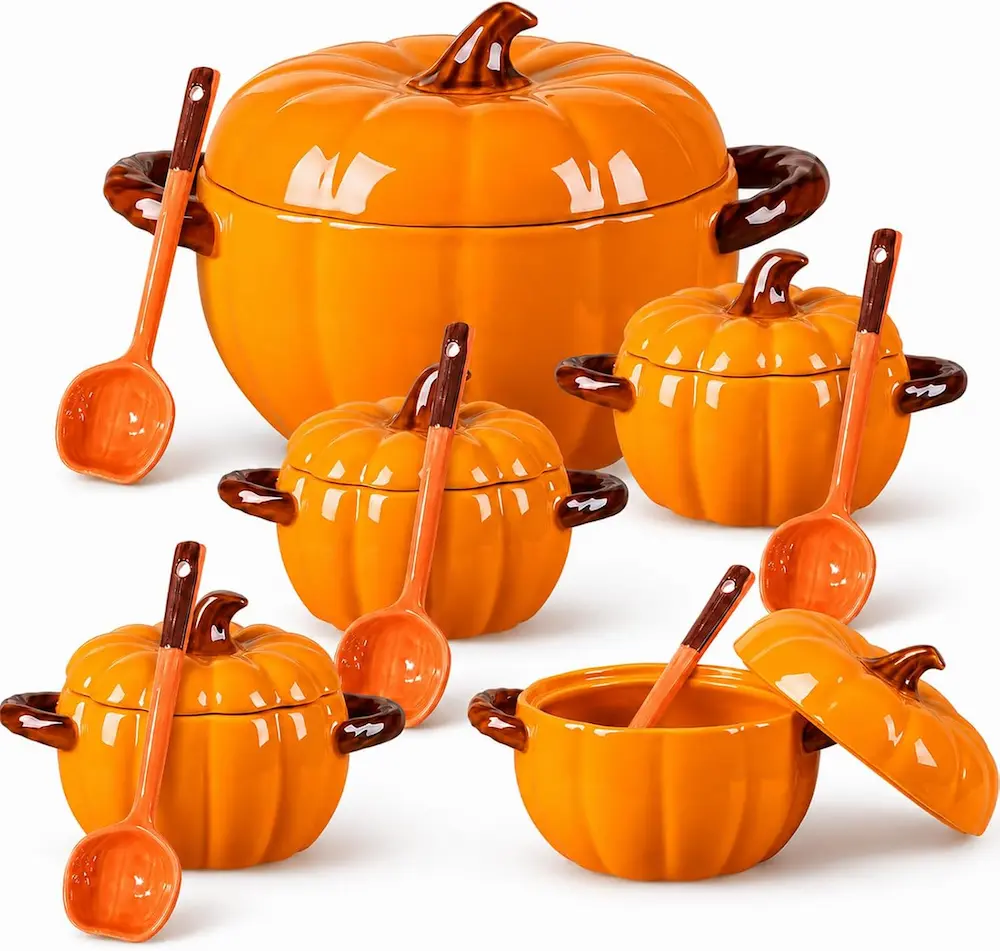
One of the most distinctive and visually memorable weeknight dinners on this site — and the one that most perfectly represents the empty nest cooking philosophy. Individual cocottes filled with ground turkey, fresh spinach, short-cut pasta, and a pumpkin-ricotta sauce topped with a sage-browned panko crust. One serving per person, served right in the individual dish. This is a recipe that could never have survived a family dinner table — too unusual, too seasonal, too adventurous. In the empty nest kitchen, it becomes a Tuesday night celebration.
⏱ Time: 35 minutes 🥩 Protein: 28g+ per serving ⭐ WW: 3–5 points
A recipe that highlights everything great about cooking for two after kids: you could never have gotten away with serving hollowed zucchini stuffed with seasoned ground turkey and Greek yogurt to a family with picky eaters. Now you absolutely can. Elegant, nearly zero-point, deeply flavorful — exactly the kind of food you want to be eating at this stage of life.
These are the Saturday dinners that remind you how extraordinary home cooking can be when you are not rushing to feed a crowd.
Lollipop Lamb Chops with Pistachio Pesto and Pomegranate Seeds
⏱ Time: 20 minutes active 🥩 Protein: 32g+ per serving ⭐ WW: 6–8 points
The KitchenAid contest winner. Published in Taste of Home. And the dinner that perfectly represents what the empty nest kitchen makes possible: you could not serve this to a six-person family of mixed palates. You can absolutely serve it to two adults who love good food. Frenched lamb chops seared to a perfect medium-rare, with vivid pistachio basil pesto and ruby pomegranate seeds. Twenty minutes of cooking. An extraordinary result.
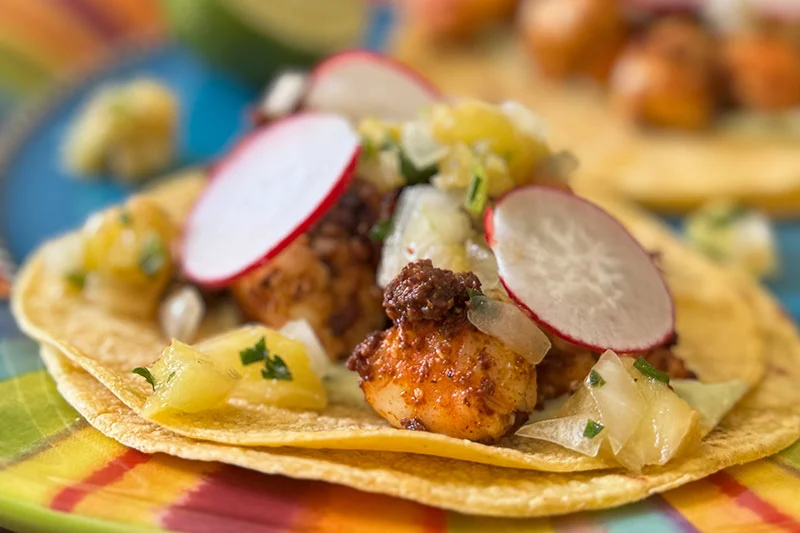
⏱ Time: 25 minutes 🥩 Protein: 30g+ per serving ⭐ WW: 5–7 points
The empty nest taco night — elevated completely beyond anything that made sense when cooking for a family. Shrimp and chorizo (lightened with beef chorizo and fat-free Greek yogurt crema) topped with a charred fresh pineapple salsa and sliced radishes. Bold, layered, genuinely restaurant-quality flavor that would have been negotiated down to plain ground beef tacos when the kids were home. Now? No compromises. Make the salsa and crema ahead of time, cook the shrimp and chorizo in minutes, and assemble at the table for a Saturday night that feels like California dining at its best.
Sheet Pan Chicken Thighs with Pomegranate and Walnuts
⏱ Time: 45 minutes (mostly hands-off) 🥩 Protein: 30g+ per serving ⭐ WW: 5–7 points
A Persian-inspired sheet pan dinner that represents everything the empty nest kitchen is about: an adventurous flavor profile (pomegranate molasses, warm spices, walnuts) that would have been a harder sell to a family table but is exactly what two food-loving adults want on a Saturday. One pan. Almost entirely hands-off. Beautiful presentation.
Panko Crusted Stuffed Chicken Thighs with Hot Honey
⏱ Time: 45 minutes (make ahead friendly) 🥩 Protein: 35g+ per serving ⭐ WW: 7–9 points
Ham and fontina stuffed inside panko-crusted chicken thighs, finished with a homemade hot honey drizzle. This is the dinner that looks and tastes like a restaurant main course and can be fully assembled in advance — roll, bread, refrigerate, bake when ready. Two perfect individual portions that look extraordinary on the plate. The empty nest reward dinner.
Not every empty nest dinner needs to be elegant. These are the cozy, satisfying meals for the nights you just want to feel at home.
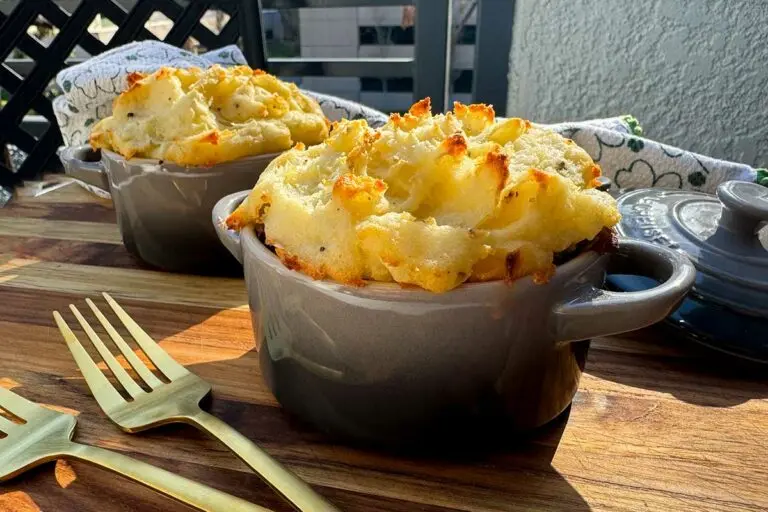
Ground Turkey Shepherd’s Pie for Two
⏱ Time: 45 minutes 🥩 Protein: 30g+ per serving ⭐ WW: 6–8 points
A properly comforting shepherd’s pie built for exactly two people. Lean ground turkey with carrots, onions, celery, peas, and corn beneath a mashed potato crust that crisps slightly in the oven. This is the kind of meal that reminds you why home cooking matters — deeply satisfying, protein-rich, exactly the right amount for two.
Cannellini Bean and Sausage Soup
⏱ Time: 45 minutes 🥩 Protein: 25g+ per serving ⭐ WW: 4–6 points
A hearty, chunky soup that is practically a stew — turkey sausage, white beans, and abundant vegetables in a rich broth. This is the soup you make on a Sunday afternoon when the house is quiet and you want something that fills the kitchen with good smell. Make a double batch and freeze half in two-cup portions for future easy lunches.
⏱ Time: 35 minutes 🥩 Protein: 30g+ per serving ⭐ WW: 4–6 points
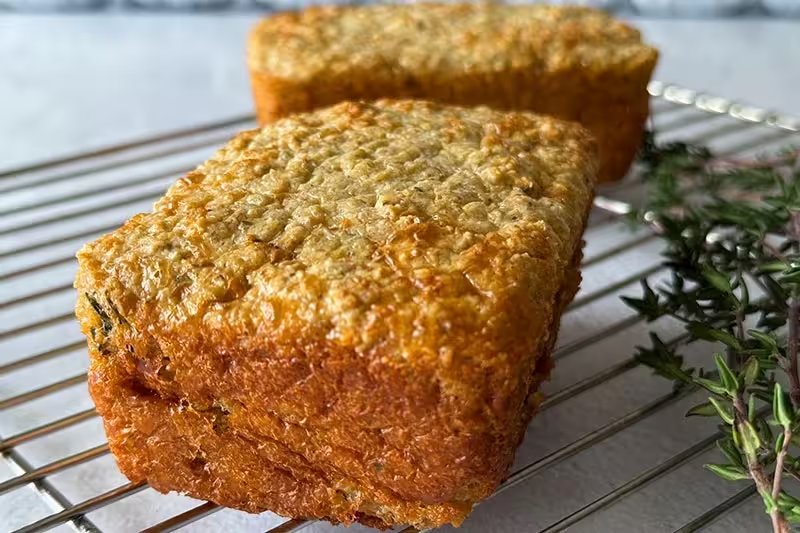
Individual mini turkey meatloaves — lean turkey packed with vegetables, oatmeal, and herbs, baked to perfect individual portions. This is comfort food scaled correctly for two people: two perfect little loaves, beautifully glazed, no enormous leftovers. Exactly what the empty nest kitchen is designed for.

With no school schedules or sports pickups to rush to, weekend brunch becomes one of the great pleasures of the empty nest. Here are the recipes worth making when you have the morning.
⏱ Time: 15 minutes 🥩 Protein: 24g per serving ⭐ WW: 2–4 points
24 grams of protein from a pancake. Without protein powder. The cottage cheese completely disappears into the batter, leaving a pancake with crispy edges and a melt-in-your-mouth interior. This is the empty nest brunch: genuinely luxurious food that happens to be extraordinary for you. Two servings. Exactly the right amount.
Eggs Benedict with Blender Hollandaise & Waffles
⏱ Time: 25 minutes 🥩 Protein: 22g+ per serving ⭐ WW: 8–10 points
The brunch that signals you have completely arrived in the empty nest chapter. Poached eggs and ham on a sweet St. Pierre brioche waffle — finished with a blender hollandaise that takes five minutes and requires zero whisking over a hot water bath. The blender method uses the heat of melted butter to gently cook the egg yolks — a chef’s secret that is about to transform your brunch game entirely. A pinch of cayenne in the hollandaise cuts through the richness. A scattering of fresh dill brings it together. This is the Saturday morning you could never have made when you had a family to rush out the door.
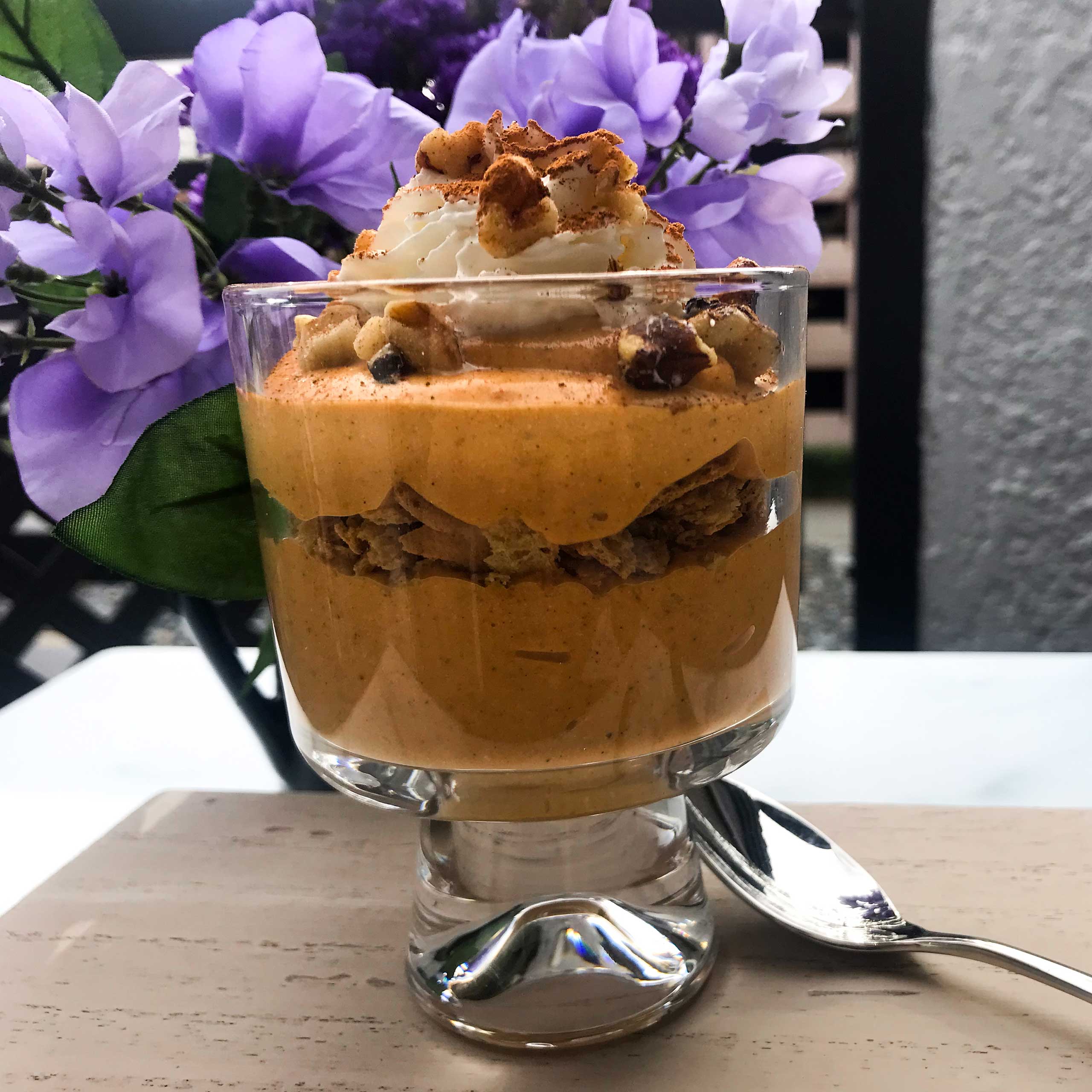
⏱ Time: 10 minutes + chilling 🥩 Protein: 15g+ protein per serving ⭐ WW: 3–4 points
The dessert that proves healthy eating in the empty nest does not mean deprivation. Fat-free cottage cheese and pumpkin puree blended completely smooth, layered over graham cracker crumbs, topped with fresh whipped cream, toasted walnuts, and a dusting of cinnamon. Light, fluffy, genuinely dessert-worthy — and also a legitimate source of protein and a full serving of vegetables. Make them ahead and chill until ready. Two perfect individual servings for two adults who have absolutely earned a sweet ending.
For the first few months after the kids leave, decision fatigue about dinner is real. The transition from cooking for a family to cooking for two requires rebuilding habits from scratch. Here is the simple framework that makes it manageable:
The Empty Nester Weekly Cooking Framework
Monday: A zero-point or near-zero-point dinner. Lean protein + vegetables + flavor toolkit. Fast, healthy, sets a clean tone for the week.
Tuesday: The ‘new recipe’ night. Now that you are only feeding two adventurous adults, Tuesday is the night to try something neither of you could have gotten away with when the kids were home.
Wednesday: A pasta, grain bowl, or plant-based dinner. Quick, minimal cleanup, naturally portioned for two.
Thursday: The ‘use up the produce’ dinner. A stir-fry, salad, or soup built from whatever is in the fridge. Reduce waste, save money.
Friday: The intentional treat. Something that feels genuinely special — a proper pasta, a date-night seafood dish, whatever you have been looking forward to all week.
Saturday: The weekend cook. Something that takes a bit more effort and is worth it. See the weekend showstoppers above.
Sunday: Plan the week, do a quick 45-minute prep (hard-boiled eggs, overnight oats, a strip of rotisserie chicken). See the full Sunday prep system in the WW-Friendly Meal Plan for Two guide.
The best empty nester recipes for two are those that take full advantage of what cooking for two makes possible: adventurous flavors that would have been a hard sell to the family table, high-quality ingredients at a manageable two-person budget, and portions that are exactly right without waste or overload. Top choices from this site include: High-Protein Waffles Made with Chicken (45–50g protein, 15 minutes, the viral flour-free waffle), Lollipop Lamb Chops with Pistachio Pesto (the most impressive-looking dinner on the site, 20 minutes active), Shrimp and Chorizo Tacos (bold California flavors, charred pineapple salsa), Pumpkin, Turkey and Pasta Cocotte en Fonte (individual cocottes — the most distinctly empty-nest dish here), and Pumpkin Parfaits for Two (a proper dessert for exactly two people). For the complete collection, see the Complete Guide to Cooking for Two.
The transition from family cooking to cooking for two requires rebuilding three systems: shopping, equipment, and recipes. For shopping: stop buying family-size packages and start buying from the meat and fish counter in two-serving quantities; buy smaller amounts of more produce varieties rather than large quantities of fewer items; and stock frozen vegetables as your waste-free backup. For equipment: you may need to supplement your large Dutch oven and skillets with a 10-inch skillet, a 3-quart saucepan, and a half sheet pan — all sized appropriately for two-person portions. For recipes: rather than scaling family recipes down (which introduces math errors and cooking time problems), seek out recipes written specifically for two servings. This site is built entirely around that two-serving default. For the complete technical guide, see the Complete Guide to Cooking for Two.
Adults in their 50s and 60s — the typical empty nester age range — have significantly increased protein needs compared to earlier in life. Research from Stanford’s Lifestyle Medicine program recommends 30–35 grams of protein per meal for adults over 50, citing anabolic resistance (the body’s decreasing efficiency at using dietary protein) as the reason higher per-meal amounts are needed. Beyond protein: omega-3 fatty acids from two to three weekly servings of seafood, fiber from diverse vegetables and legumes, and calcium and vitamin D for bone density. The empty nest transition is the ideal moment to reset nutrition because for the first time in decades, you can cook exactly what you want to eat — which means you can actually eat the foods that serve your health at this life stage without compromise.
Yes — and it is particularly well-timed. The WW program and cooking for two are almost perfectly aligned: both benefit from precise portioning (cooking for two produces exactly two servings, eliminating the second-helpings temptation), both reward quality over quantity, and both work best when the food is genuinely delicious rather than a deprivation compromise. The empty nest grocery budget often decreases substantially, which can cover WW membership costs. And the empty nest lifestyle — more flexibility, more control over the kitchen, fewer competing palates — makes it easier to follow a consistent eating plan than it ever was when cooking for a family. For the complete WW-for-two approach, see the Cooking for Two on Weight Watchers guide.
Three concrete strategies. First, find recipes written for two servings rather than scaling four- or six-serving recipes down — scaling introduces errors in both quantities and cooking times. This site defaults to two-serving recipes throughout. Second, recalibrate your shopping: buy proteins in exact two-serving quantities from the counter rather than buying family packs. Third, build the ‘planned-overs’ habit rather than the ‘leftovers’ habit — when you intentionally make a slightly larger batch of a grain or a protein component, you repurpose it deliberately into a completely different meal the next day rather than eating the same meal twice. A batch of roasted chicken becomes a salad, then a stir-fry, then a soup — three different meals from one cooking session. For more on this approach, see the Complete Guide to Cooking for Two.
The essential pieces for a two-person kitchen: a 10-inch skillet (the workhorse for searing, sautéing, and pan sauces for two), a 3-quart saucepan (properly sized for pasta and sauces without over-reducing), a half sheet pan (for sheet pan dinners for two), a small Dutch oven in the 2–3 quart range (for braises and soups without the volume that causes a 6-quart to reduce too aggressively), and an 8×8 baking dish (the two-person equivalent of the family 9×13). Most of these you may already own — the gap is usually in the small-scale pieces rather than the large ones. A digital kitchen scale is genuinely transformative for two-person cooking because it eliminates the guesswork of halving recipes that use volume measurements.
The empty nest kitchen confronts many couples with a truth that the family dinner table obscured: your food preferences may have diverged more than you realized over the years of compromise cooking. The practical solution is the shared base, separate additions approach. Cook a zero-point or low-point protein and vegetable base that works for both of you. Then serve the higher-point, more polarizing elements — a sauce, a spice level, a specific side — in separate bowls that each person adds according to their own preference. The dinner is genuinely the same for both people; each person customizes at the table. This approach works particularly well with the recipes on this site, which are designed around a zero-point protein-and-vegetable base with additions as the variable. See the Cooking for Two on Weight Watchers guide for the full couples-cooking system.
Burnout from two decades of cooking for a family is completely real and completely valid. The antidote is usually one of three things: permission to cook only things you actually want to eat (which the empty nest now grants you fully), a new ingredient or cuisine you have never tried before (the empty nest is the perfect time to start), or a complete removal of the obligation mindset around dinner. Cooking for two at its best is not an obligation — it is a creative act for an audience of one person who loves you and appreciates the effort. Start with the shortest, most low-stakes recipes first: a twenty-minute salmon fillet with a pan sauce, or a bowl of something simple and high-protein. Let the pleasure of a good meal that takes twenty minutes remind you why cooking matters. Then gradually work your way toward the dinners that require more from you, as the joy returns. The Complete Guide to Cooking for Two has the full practical framework for rebuilding a cooking routine.
The empty nest transition typically coincides with the period — roughly ages 50 to 65 — at which protein needs increase most significantly due to anabolic resistance, accelerating muscle loss, and hormonal changes (particularly for women around menopause). The updated 2025–2030 Dietary Guidelines recommend 1.2–1.6g of protein per kilogram of body weight daily for adults over 50, compared to the previous 0.8g/kg standard. For a 150-pound person, that means 82–109 grams per day, or roughly 30 grams per meal. Practically, the most effective approach is the protein-stacking method described in the 30 Grams of Protein Dinners for Two guide: combine two protein sources in each meal (salmon plus edamame, chickpea pasta plus ground turkey, eggs plus cottage cheese) rather than relying on one large portion of a single protein. The recipes on this site were built around this exact target. The High-Protein Breakfasts for Two guide covers the breakfast angle, which research shows is where most people over 50 are leaving the biggest protein gap.
I want to be honest with you about something: I was never the cook who needed her kids to leave to find her kitchen. My two-person cooking life has been my default for a long time. But I have watched the transition happen for dozens of people around me — nieces getting their first apartments, friends becoming empty nesters, coworkers whose last child just went to college — and I can tell you with complete confidence what the ones who flourish in the empty nest kitchen have in common.
They decide, deliberately, that this is not a diminishment. That cooking for two is not a lesser version of cooking for a family — it is a different, and in many ways better, version. Better ingredients. More variety. Perfect portions. Food you actually want to eat. A kitchen that is yours again.
That decision — to see this as a beginning rather than an ending — is the most important ingredient in every recipe in this collection.
For the complete two-person cooking system: Complete Guide to Cooking for Two. For the WW-friendly approach: WW-Friendly Recipes Guide. For the high-protein recipe collection that supports healthy aging: High-Protein Recipes Guide. For the 7-day meal plan: WW-Friendly Meal Plan for Two — 7 Days.

Hi! I’m Diane. I started this site as a passion project. I love to cook, entertain, travel and laugh. (Who doesn’t love a good laugh?) Of course, being from New York, sarcasm rules!
More About Diane
mycuratedtastes@gmail.com