Add Us As A Trusted Google Source
 Zero-Point Recipes for Two: Real Food, Real Meals, Zero Points
»

After reading this guide you will know exactly how to:
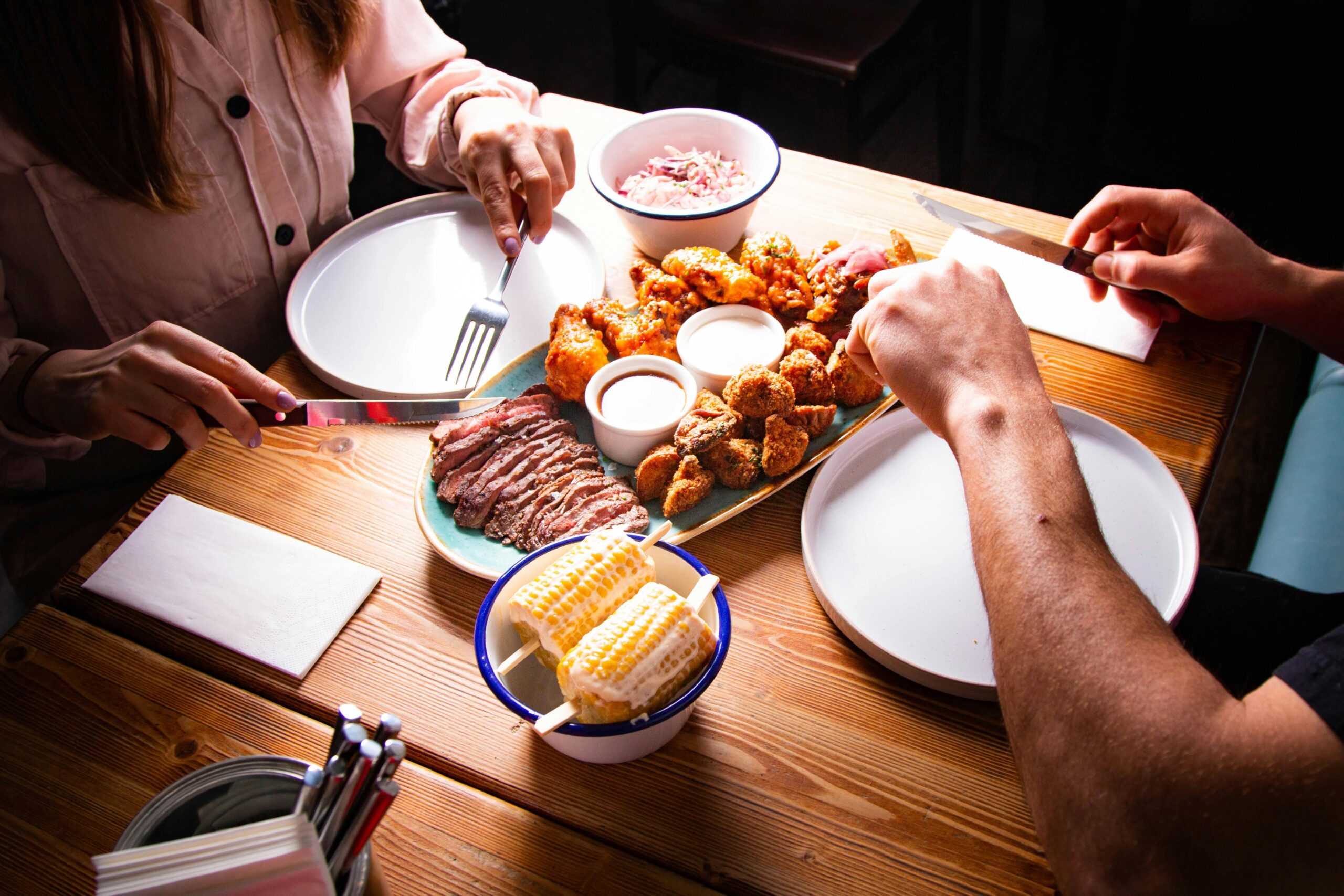
I have been cooking for two consistently for over ten years. There were big chunks of my life, where cooking for one or two was also the norm, but in those recent ten years, I have lost count of how many times I have found a recipe I was genuinely excited about — only to realize it served eight people and I had nobody coming for dinner but my roommate, friend, or date. The math seems obvious: just divide everything in half and you’d have one serving now and one for lunch tomorrow. But anyone who has tried that and ended up with a rubbery, over salted, or completely flat version of something that looked amazing online knows the truth.
Scaling a recipe down to two servings is not just math. It is cooking science. The way ingredients interact changes at smaller volumes. The way your pan conducts heat changes. The way salt tastes changes in smaller quantities. The way baking chemistry behaves changes when you halve a batch. And if you are also cooking with Weight Watchers in mind — which I am, every single day — scaling adds another layer: how do the points change when the portions change?
This is the complete guide I wish existed when I started. It covers everything the top-ranking posts cover — the conversion formula, the tricky ingredients, the pan sizes — and then it goes further, with the WW-specific angle and the protein-tracking perspective that nobody else has written about. Because when you are cooking meals for two that are also Weight Watchers friendly and high in protein, scaling correctly is not optional. It is the foundation of the whole system.
Every successful recipe scaling starts with one calculation. You do not need to be a mathematician. You need to divide two numbers.
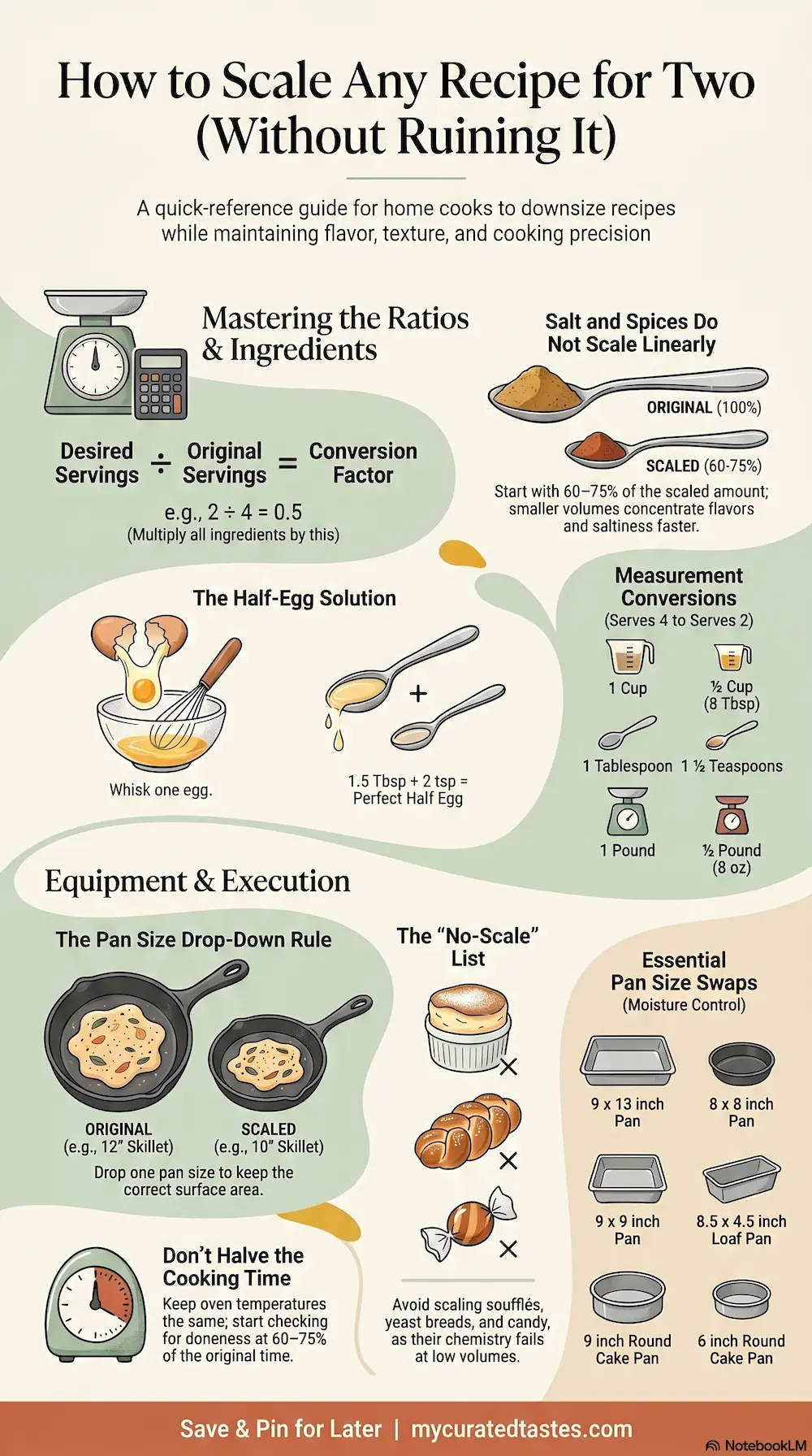
Desired Servings ÷ Original Servings = Conversion Factor
Then multiply every ingredient by your conversion factor.
Examples: Recipe serves 4 → you want 2 → factor is 0.5 (halve everything)
Recipe serves 6 → you want 2 → factor is 0.33 (divide everything by 3)
Recipe serves 8 → you want 2 → factor is 0.25 (divide everything by 4)
Write your conversion factor down before you start cooking. Write the new amounts next to each ingredient in the recipe. The single biggest scaling mistake — confirmed by every professional cook I have ever talked to — is not the formula. It is forgetting to apply the formula to one or two ingredients halfway through the recipe because you are going back and forth between the original and your calculations. Write it down first. Then cook.
Here is the chart to print and stick on your fridge. These are the conversions you will use most often when scaling recipes from four servings down to two:
| Original Amount (serves 4) | Halved Amount (serves 2) | Kitchen-Friendly Equivalent |
|---|---|---|
| 1 cup | ½ cup | 8 tablespoons |
| ¾ cup | 6 tablespoons | 6 tablespoons |
| ⅔ cup | ⅓ cup | 5 tablespoons + 1 teaspoon |
| ½ cup | ¼ cup | 4 tablespoons |
| ⅓ cup | 2 tablespoons + 2 teaspoons | 2 tablespoons + 2 teaspoons |
| ¼ cup | 2 tablespoons | 2 tablespoons |
| 1 tablespoon | 1½ teaspoons | 1½ teaspoons |
| 1 teaspoon | ½ teaspoon | ½ teaspoon |
| ½ teaspoon | ¼ teaspoon | ¼ teaspoon |
| ¼ teaspoon | ⅛ teaspoon | A small pinch |
| 1 pound | ½ pound | 8 ounces |
| 1 egg (large) | ½ egg | Whisk 1 egg, measure 2 tablespoons |
| 2 eggs | 1 egg | 1 whole egg |
| 3 eggs | 1½ eggs | 1 whole egg + 1 tablespoon whisked egg |
This is where most home cooks go wrong. The formula works perfectly for most ingredients. But a handful of ingredients behave differently at smaller volumes, and if you apply the formula blindly to them, your food will not taste right. Here is the complete list with exactly what to do instead.
Salt perception is not linear. When you cook a smaller volume of food, the liquid reduces faster, concentrating the salt more quickly than in a larger batch. Start with 60–70% of the scaled amount, taste as you go, and add more only if needed. This is especially important for braises, stews, and sauces.
My rule: If the full recipe calls for 1 teaspoon salt and you are halving it, start with ⅓ teaspoon rather than ½ teaspoon. You can always add more. You cannot take it out.
Garlic, chili pepper, cumin, paprika, ginger, and other potent aromatics intensify in smaller volumes because there is less liquid to dilute them. Start at 75% of the scaled amount. So if the halved recipe calls for 1 teaspoon of garlic powder, start with ¾ teaspoon.
The one exception: dried herbs like oregano, thyme, and rosemary. These can usually be scaled at the full 50% without issue because they are more forgiving in smaller batches.
Unlike salt and spices, leavening agents must be scaled exactly. They work based on their ratio to flour, not to the total batch size. If the original recipe has 2 cups flour and 2 teaspoons baking powder and you are halving it, you need 1 cup flour and exactly 1 teaspoon baking powder. Same ratio, every time. Too much leavening creates a chemical aftertaste and weird texture. Too little and your baked goods will not rise.
Yeast scales linearly by weight, but smaller doughs behave differently during fermentation. A half-batch of bread dough may rise faster than the original recipe suggests because there is less mass resisting the yeast activity. Watch the dough, not the clock. The first rise might take 45 minutes instead of 60. The second rise might take 20 minutes instead of 30.
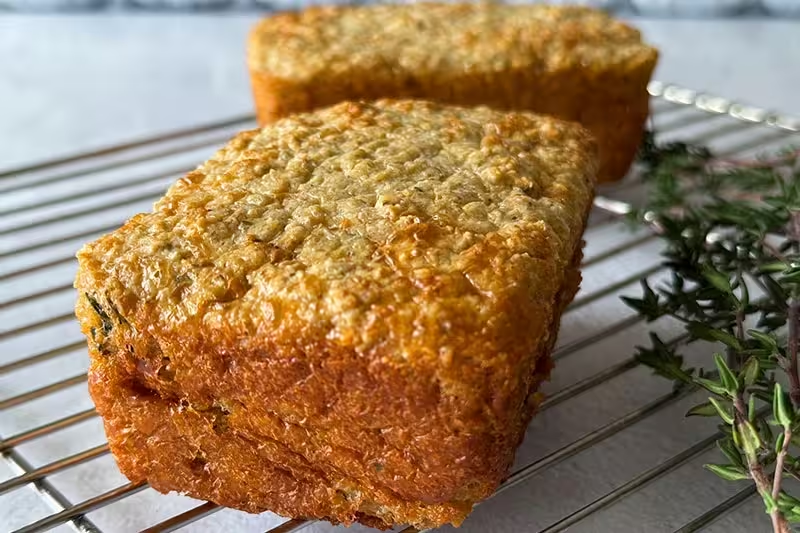
This is also why most bread recipes are notoriously difficult to scale down for two. Small-batch yeast bread is its own skill. For quick breads and baking powder-leavened items like my Cottage Cheese Bread with Oatmeal, halving works beautifully because there is no fermentation variable.
This is the most commonly misunderstood scaling element. The amount of oil or butter you need for sautéing is determined by the size of your pan, not by the recipe’s original serving count. When you scale down a recipe for two, you also drop to a smaller pan (more on this below). Your smaller pan needs enough fat to coat the bottom — which may be less than what the formula gives you, or it may be similar. Use your eye and your pan, not the number.
Halving one egg feels impossible. It is actually very simple. Crack the egg into a small bowl and whisk the yolk and white together until fully combined. A standard large egg weighs about 50 grams and equals approximately 3 tablespoons + 1 teaspoon of liquid. Half an egg is about 25 grams or 1½ tablespoons + 2 teaspoons. And while we are talking about grams, scaling and weighing, get yourself a digital kitchen scale and up your cooking skills. It can be a game changer if you’ve never used one.
Freeze the unused half in an ice cube tray. Label it. Use it within two months for scrambled eggs or an egg wash.
For odd numbers of eggs: If the full recipe calls for 3 eggs and you are halving it, you need 1½ eggs. Use 1 whole egg plus ½ egg measured as above. Write the number down before you start cracking so you do not lose track.
Acids scale linearly in most cases. However, in smaller volumes they can taste sharper because there is less other liquid to balance them. Taste before adding the full scaled amount and adjust if needed.
If I could tell every home cook one thing about scaling recipes for two, it would be this: changing the pan size is not optional. It is the most important step, and it is the one most people skip.
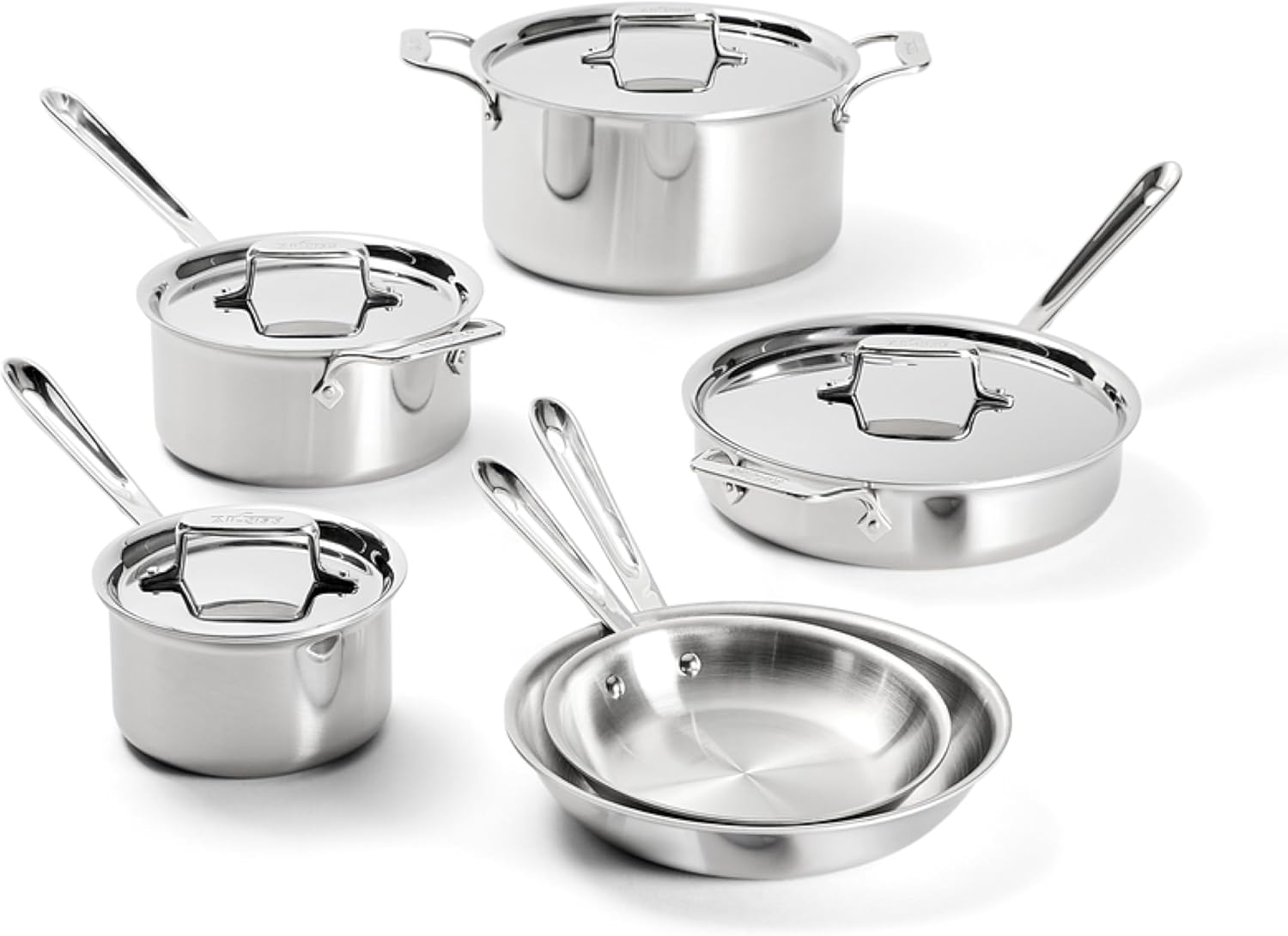
When you halve a recipe, you cannot use the same pan. Here is why: a recipe written for four servings was developed and tested in a specific pan. That pan’s surface area, depth, and heat distribution are all baked into the cooking time and temperature. If you put half the ingredients into the same full-sized pan, they spread too thin. Moisture evaporates too quickly. Proteins overcook before they develop any color. Baked goods come out dry or unevenly cooked.
When halving a savory recipe, drop down one pan size. Here are the most common swaps:
| Original Pan (serves 4) | Scaled Pan (serves 2) |
|---|---|
| 12-inch skillet | 10-inch skillet |
| 10-inch skillet | 8-inch skillet |
| Large Dutch oven (6+ qt) | Small Dutch oven (3–4 qt) |
| Large saucepan (4 qt) | Small saucepan (2 qt) |
| Large stockpot (8 qt) | Medium saucepan (4 qt) |
One important nuance: different pan materials conduct heat differently. If you are swapping from a large nonstick skillet to a smaller stainless steel pan, the stainless steel runs hotter. Start checking your food earlier than you think you need to. My go-to pan for most of my two-person cooking is a well-seasoned 10-inch cast iron skillet — it maintains consistent heat at smaller scale beautifully.
Baking pan math is based on surface area. When you halve a baking recipe, you need a pan with approximately half the surface area. Here are the most commonly used swaps:
| Original Baking Pan | Scaled Pan (serves 2) |
|---|---|
| 9×13 inch (117 sq in) | 8×8 inch (64 sq in) — closest option |
| 9×9 inch (81 sq in) | 8.5×4.5 inch loaf pan (38 sq in) |
| Two 8-inch round cake pans | One 8-inch round cake pan |
| 9-inch round cake pan | 6-inch round cake pan |
| Standard 12-cup muffin tin | 6-cup muffin tin or standard tin half-filled |
| 9×5 inch loaf pan | Mini loaf pan (5.75×3 inch) |
My small-batch baking essential: a quarter sheet pan. Almost every recipe I bake for two starts there. From my Honey Nut Cluster Cookies to small-batch brownies, the quarter sheet pan is the workhorse pan for a two-person kitchen. Go wild and add a 1/2 sheet pan for larger, vegetable centered dinners. Then, you’ll be ready to tackle anything.
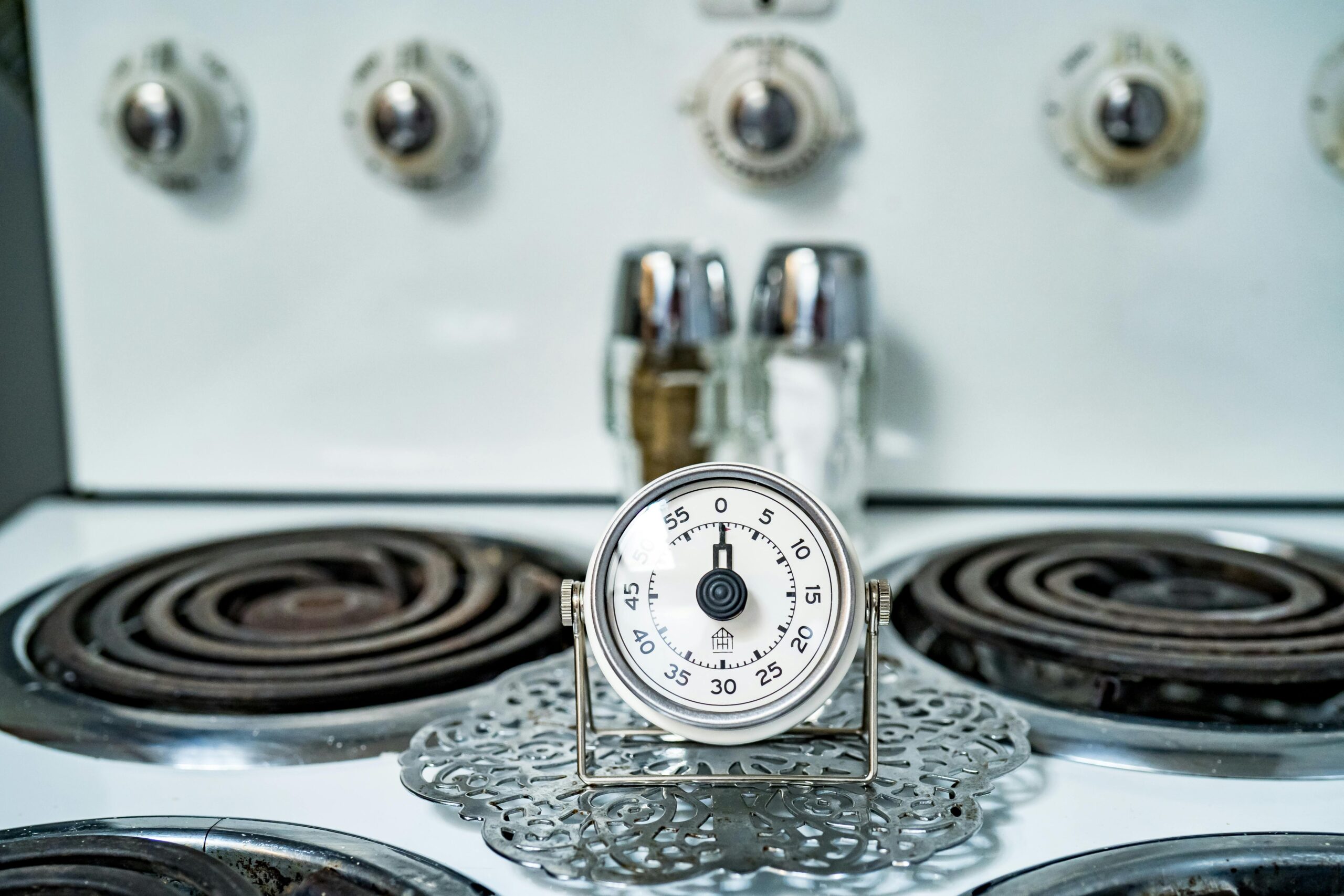
Here is what confuses most people: halving the food does not mean halving the time. The oven temperature stays the same. What changes is how quickly heat reaches the center of whatever you are cooking, and that depends on the thickness and density of the food — not just the quantity.
Keep the oven temperature exactly the same. Smaller batches will be done faster — start checking at 60–75% of the original cooking time. Do not set a timer for half the time and walk away. Set it for 60–65% of the original time and start checking from there, every 5 minutes, until done.
Use visual and temperature cues, not just time. A meat thermometer is not optional when cooking for two — it is the single tool that will save more recipes than anything else. For my Teriyaki Salmon Bowls scaled for two, I pull the salmon the moment it reads 125–130°F internally rather than relying on time. Perfect every time.
Sautéing and searing times stay almost the same when you use the correct smaller pan. The food is in a smaller pan with proper coverage, so the heat exposure is similar to the original recipe. What changes: reduction times. Sauces, gravies, and pan sauces will reduce faster in a smaller pan because there is less liquid and more surface area relative to volume. Watch reductions closely and pull them off heat sooner than the recipe suggests.
Slow cooker scaling for two is the trickiest. Most slow cookers are designed for 4–6 servings minimum, and halving into a large cooker often results in overcooked food because the heating elements around the sides reach a smaller volume of food more intensely. If you regularly cook for two in a slow cooker, invest in a 1.5–2 quart mini slow cooker. It will change the way you use this appliance for small-batch cooking.
When you’ve made the recipe, write down how long it took for that perfect cook. Save it, so the second time you tackle that recipe, you know exactly how long it will take to cook the recipe perfectly. Remember, there are lots of variable from how your oven heats, to the type of pan/dish you used, to thickness of meat, etc. So keeping great notes will make every recipe better the second and third time you make it. Enjoy the process, have fun with it, and don’t be scared!!!
Baking is chemistry, and chemistry does not always scale predictably. Savory cooking is forgiving — you can adjust as you go. Baking is not. Here are the specific rules that make small-batch baking work.
If a recipe genuinely does not scale down reliably, make the full batch and portion strategically. Freeze half immediately before anyone eats it — out of sight, out of mind. Or plan to take leftovers somewhere. Or find a recipe that was developed for two servings from the start. My entire recipe library at My Curated Tastes is built around this philosophy — most of my recipes serve exactly two people without any scaling required.
This section does not exist on any other recipe scaling guide. I wrote it because I need it, and I suspect you do too.
When you are cooking with Weight Watchers in mind, scaling a recipe is not just about the food. It is about the points. And scaling affects points in ways that catch a lot of people off guard.
The WW point value of a dish is calculated per serving. When you scale a recipe down to two servings, the total points in the dish decrease proportionally — but the points PER SERVING stay the same as the original, assuming you are eating a true half. The problem comes when scaling changes the serving size in a way that is not obvious.
Example: A pasta recipe for four calls for 2 cups of pasta total (½ cup per serving). Scaled for two, that becomes 1 cup of pasta total (still ½ cup per serving). The points per serving are identical. But if you scale down incorrectly and end up with a smaller total dish and eat half of it thinking you are eating one serving — you may actually be eating a larger serving proportion than you realize.
My rule: Always calculate total dish weight or volume before and after scaling, and divide by your intended number of servings. Do not eyeball serving size on a scaled recipe until you have made it several times and know what the correct serving looks like.
When you scale down, high-point ingredients like olive oil, butter, cheese, and pasta concentrate the points into a smaller total volume. This means that even though the recipe mathematically produces the same points-per-serving, your satisfaction from a smaller total dish may be lower — which leads to eating more.
My solution: when scaling a WW-tracked recipe down to two servings, look at the high-point ingredients and consider whether there is an opportunity to swap rather than just halve. If the full recipe uses 4 tablespoons of butter and you are halving to 2 tablespoons, ask whether 1.5 tablespoons plus a splash of pasta water or chicken broth would give you the same result. In many cases it will — and you save points without sacrificing flavor. This is the kind of swap that shows up throughout my WW-friendly recipe collection. You can also refer to my 23 food swap to make weight loss painless guide. I have lots of great swaps listed there.
If you are tracking protein alongside WW — which I do every day — scaling correctly is critical for hitting your protein targets. When you halve a recipe, the protein per serving stays the same as the original, assuming correct proportioning. But if you reduce the protein component more than other components (for example, using 6 ounces of chicken instead of 8 because you are cutting costs), your protein per serving drops disproportionately.
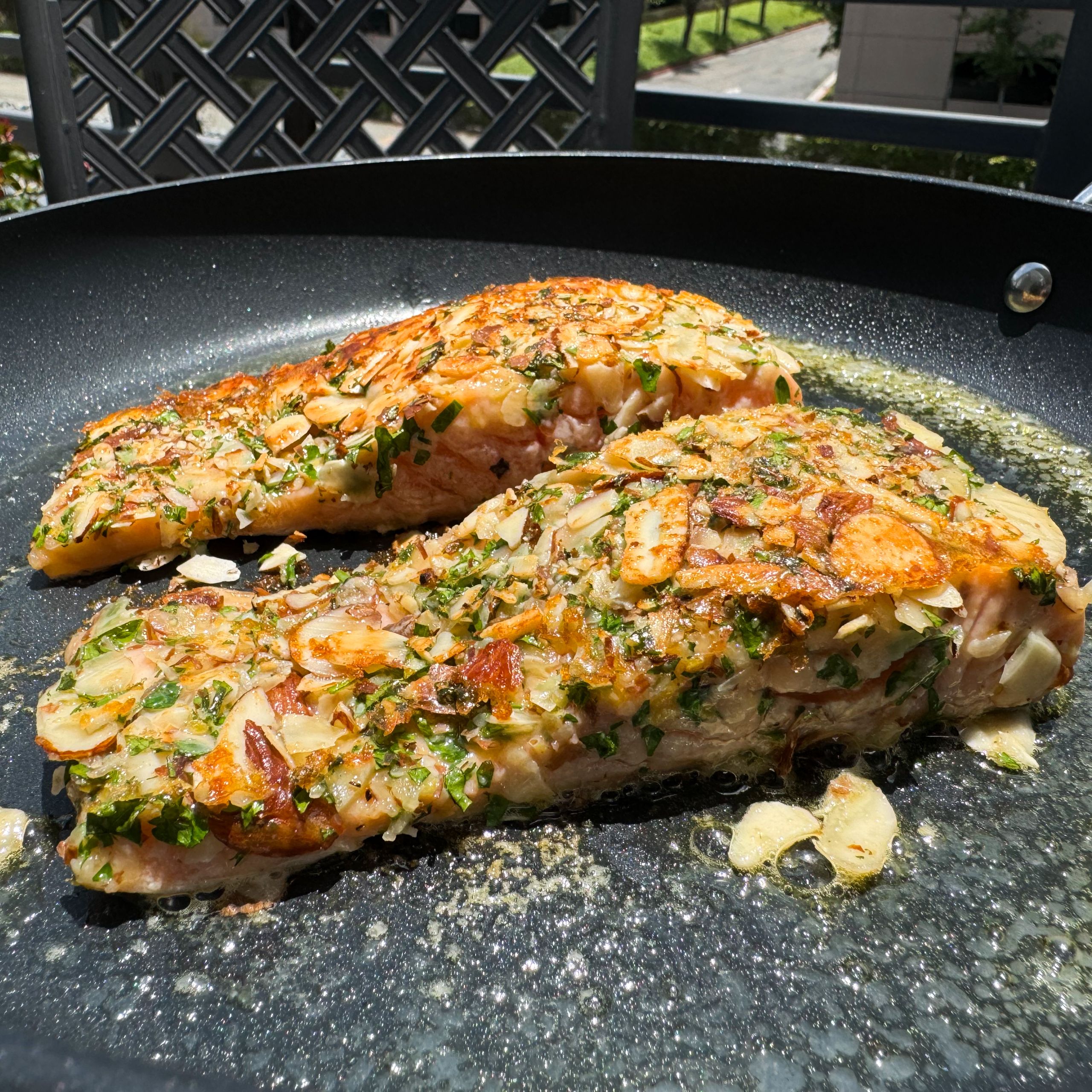
My rule for protein: When scaling a high-protein recipe down to two servings, scale the protein component last and only to the minimum needed to hit your target. If a recipe calls for 1 pound of salmon for four people, scale to 8 ounces for two — and do not reduce further. Protein is the ingredient that earns its full proportion every time. See my High-Protein Recipes Guide for more on building protein-forward meals for two.
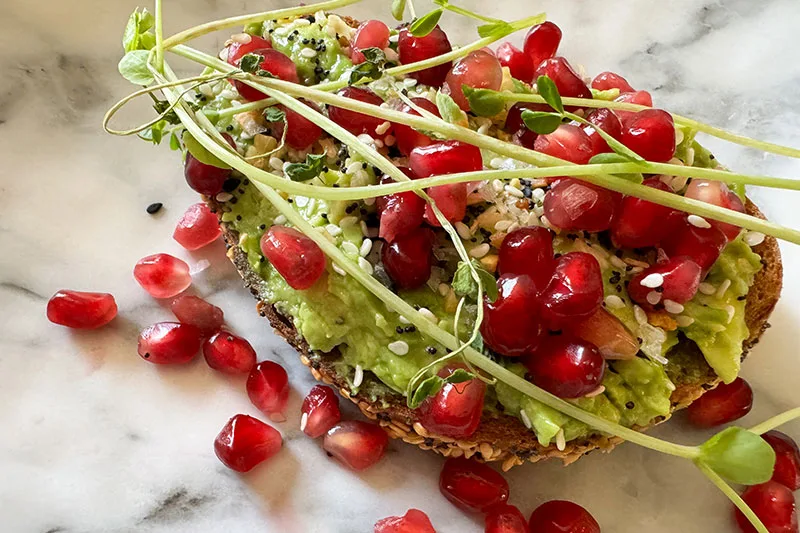
Most of my recipes on My Curated Tastes were developed with a two-person household in mind, which means most of them are already sized for two and require no scaling at all. But here are some of my favorites that also illustrate the scaling principles in this guide:
For a complete collection of recipes already sized for two, visit my Cooking for Two Guide — it is your complete resource for two-person cooking from weeknight dinners through small-batch baking.
Some recipes are simply not designed to scale. Trying to force them into a smaller format leads to failure, frustration, and wasted ingredients. Here is my honest list, built from years of trial and error:
To scale a recipe from 4 servings to 2 servings, multiply every ingredient by 0.5 (divide by 2). This is your conversion factor. However, do not apply this blindly to salt and spices — start those at 60–75% of the scaled amount and taste as you go. Also drop to a smaller pan: a recipe developed in a 12-inch skillet for four will need a 10-inch skillet for two. See the full conversion factor formula and quick-reference measurement chart above.
To scale a recipe from 6 servings to 2 servings, multiply every ingredient by 0.33 (divide by 3). For a recipe that serves 8, the factor is 0.25 (divide by 4). Write down all the new amounts before you start cooking. For baking recipes, change to a pan with approximately one-third the surface area of the original. For savory cooking, move to a significantly smaller pan and watch cooking times carefully — a smaller volume of food will be done faster.
To halve an egg, crack it into a small bowl and whisk the yolk and white together until fully combined. A standard large egg equals approximately 3 tablespoons + 1 teaspoon of liquid. Half an egg is approximately 1½ tablespoons + 2 teaspoons (or about 25 grams on a kitchen scale). Use that amount in your recipe and freeze the remaining half in an ice cube tray for future use.
Yes, cooking times typically decrease when you scale a recipe down, but not in a straight proportion. The oven temperature should stay the same — only the time changes. For baked goods and roasted items, start checking at 60–75% of the original cooking time. For stovetop cooking, times stay similar if you use the correct smaller pan. Sauces and reductions will finish faster because smaller volumes reduce more quickly. Always use visual cues and a meat thermometer rather than relying solely on time.
The formula for scaling a recipe is: Desired Servings ÷ Original Servings = Conversion Factor. Multiply every ingredient by the conversion factor. Examples: 2 ÷ 4 = 0.5 (halve the recipe); 2 ÷ 6 = 0.33 (take one-third of the recipe); 2 ÷ 8 = 0.25 (take one-quarter of the recipe). After calculating the factor, adjust salt and spices conservatively (60–75% of the calculated amount) and change to the appropriate smaller pan.
No. Oven temperature should never be changed when scaling a recipe. The temperature in a baking recipe is set to achieve specific chemical reactions — browning, rising, setting — that are not related to batch size. What changes is the cooking time, because smaller quantities cook faster. Keep the temperature exactly the same and start checking for doneness earlier than the original recipe indicates.
Salt and spices should not be halved directly — start at 60–75% of the calculated halved amount and taste. Cooking fats for sautéing should be based on pan size, not recipe math. Leavening agents (baking powder, baking soda) should be scaled precisely according to their ratio to flour. Yeast should be scaled by weight but monitored carefully because rise times change at smaller volumes. Acidic ingredients like lemon juice and vinegar scale linearly but may taste sharper in smaller volumes — taste before adding the full amount.
No. Using the same pan when halving a recipe is the most common mistake in recipe scaling. A halved recipe needs a pan with approximately half the surface area of the original. Savory cooking: drop one pan size (12-inch skillet → 10-inch skillet). Baking: move to a pan with half the area (9×13 → 8×8, or a loaf pan for round cakes). Using too large a pan causes thin spreading, over-evaporation, uneven cooking, and dry or rubbery results.
Scaling a recipe down to two servings does not change the WW points per serving, as long as you are eating a correctly proportioned serving of the smaller total batch. The total points in the dish decrease proportionally, but points per serving stay the same. The risk is eyeballing serving size on a scaled recipe and unintentionally eating a larger portion than intended. Always weigh or measure serving size the first several times you make a scaled recipe. Also use scaling as an opportunity to swap — reduce high-point ingredients like butter or cheese slightly more than the formula suggests and replace with lower-point alternatives to build a smarter version of the dish.
When scaling recipes for two with protein in mind, scale the protein component last and protect it. Do not reduce protein below the per-serving target you are aiming for — typically 25–50 grams per serving for a high-protein meal. If a full recipe uses 1 pound of chicken for four people, use the full 8 ounces for two. Protein is the ingredient that earns its full proportion every time. If budget is a concern, reduce other components (pasta, rice, vegetables) slightly before reducing the protein. See specific high-protein two-serving recipes in my High-Protein Recipes Guide.
Start with the conversion factor: divide your longtime family recipes by the number of servings and multiply by 2. Write down all the new amounts before you start. Then make three changes to your kitchen: invest in a 10-inch skillet, an 8×8 baking dish, and a digital kitchen scale. These three pieces of equipment solve 80% of the problems that come up when cooking for two. Also consider building a collection of recipes written specifically for two from the start — visit my Cooking for Two Guide for over 20 tested recipes that need no scaling at all.
Baked goods fail when halved for one of four reasons: wrong pan size (most common — the pan is too large and the batter spreads too thin), incorrect leavening (baking powder and soda must be scaled precisely to their flour ratio), inaccurate measurement (volume measurements become less accurate at small amounts — use a scale), or wrong cooking time (halved baked goods are done faster; start checking at 60% of the original time). Fix the pan first. Then measure by weight. Then watch the oven closely.
I have been scaling recipes for two for over ten years. Early on I made every mistake in this guide — the wrong pan, the over-salted sauce, the flat baked goods, the rubbery egg dish. Every failure taught me something. And what I know now is that scaling is genuinely learnable, and once you have the formula and the rules in your head, it becomes second nature.
The most important mindset shift: stop treating large-format recipes as the default and adjusting down as the exception. If you cook for two people most days, two-serving recipes should be your baseline and anything larger should be the exception. That is the philosophy behind every recipe on My Curated Tastes — cooking for two is not a compromise. It is the goal.
Bookmark this page, print the conversion chart, and come back whenever you need it. And when you want recipes that are already perfectly sized — no math required — visit my complete Cooking for Two Guide, where you will find everything from weeknight dinners through small-batch desserts, all developed and tested for exactly two servings.

Hi! I’m Diane. I started this site as a passion project. I love to cook, entertain, travel and laugh. (Who doesn’t love a good laugh?) Of course, being from New York, sarcasm rules!
More About Diane
mycuratedtastes@gmail.com